How RSV spreads: lessons from a 1981 transmission study
A 1981 human exposure study detected RSV infections after close infant care and contact with contaminated objects, but none among adults kept more than six feet away without touching the environment. These findings support contact and close-range spread without ruling out inhalation in other settings.
Three exposure groups helped compare transmission conditions. Its conclusion about “small-particle aerosol” spread needs caution alongside current CDC and WHO guidance.

Evidence last checked 25 Jun 2026 · 4 min
What the 1981 study was trying to separate
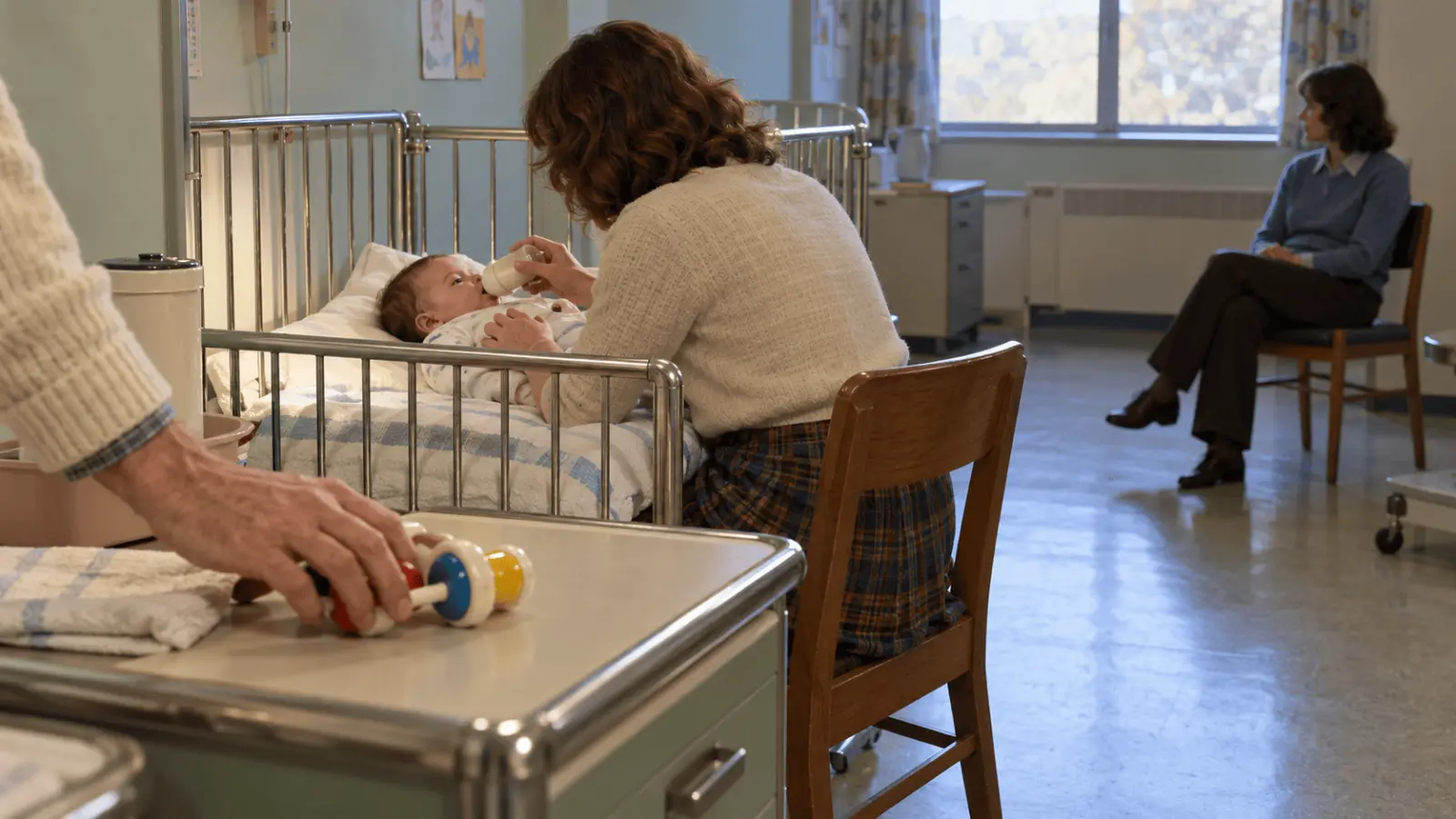
In July 1981, C. B. Hall and R. G. Douglas Jr. published a study in The Journal of Pediatrics investigating how RSV spread in hospitals. Three exposure settings compared close care, contaminated objects and distant no-touch exposure.
Investigators assessed infection through viral isolation, serology and symptoms, rather than symptoms alone.
How the three exposure groups differed
Close-care exposure
The “cuddlers” fed, changed and played with an infected infant for two to four hours. Respiratory exposure, direct contact and self-inoculation were all possible, so infections could not be assigned to one route.
Contaminated-surface exposure
The “touchers” handled secretion-contaminated bedside objects after the infant left. This tested possible hand-to-face transfer from surfaces. Earlier research had found RSV could remain viable temporarily on hands and objects.
Distant exposure
The “sitters” stayed more than six feet (about two metres) from the bed for over three hours without touching objects. No infections were detected. This was one distant-exposure setup, not a test of every inhalation scenario.
What the experiment found
Infections occurred after close care and surface contact, but not distant exposure. Infected close-care volunteers had more severe symptoms. The results supported close-range and contact-related routes. The three settings did not establish the importance of every transmission route.
Exposure condition | What participants did | 1981 outcome | What it can support |
Close care | Cared for infected infant for 2–4 h | Infection detected | Close-range/contact transmission occurred, but the route was not isolated |
Surface contact | Touched secretion-contaminated bedside objects | Infection detected | Environmental contact with later self-inoculation was plausible |
Distant no-touch | Sat >6 ft away for >3 h; touched nothing | No infection detected | No infection under this specific distant exposure condition |
Why the aerosol conclusion needs modern caution
The 1981 terminology divided droplets from small aerosols. Modern research recognizes a continuum of particle sizes influenced by airflow, ventilation, distance and humidity. A 2021 Science review challenged rigid droplet-versus-airborne categories.
The negative sitter result applies only to that exposure. It does not exclude inhalation at closer distances, with different ventilation or over longer periods. The 31 volunteers were healthy adults, not infants.
How the historical finding fits current RSV guidance
CDC and WHO describe RSV transmission through respiratory particles, direct contact and contaminated surfaces. Their guidance extends beyond the 1981 distant-exposure result.
Healthcare prevention combines hand hygiene, cleaning, respiratory hygiene, patient placement, indicated protective equipment and indoor-air measures. The 1981 findings remain relevant to contact precautions, but modern practice uses broader evidence.
What the study can and cannot tell us
The experiment directly compared distinct exposure settings, but its small scale limits the conclusions. Key limitations include:
- the small sample limits the interpretation of a negative result in any exposure group;
- close-care exposure allowed several transmission mechanisms simultaneously, preventing attribution to one route;
- “small-particle aerosol” was represented by one distant exposure setup rather than a range of ventilation and proximity conditions;
- healthy adults were used as volunteers, while severe RSV burden and hospital transmission are especially important in infants and other high-risk patients;
- current concepts of respiratory particle transmission are more nuanced than the droplet/aerosol categories used in 1981.
This single experiment offers limited evidence for ranking transmission routes. It supports transmission through close contact and contaminated environments, without excluding inhalation.
Frequently asked questions
Does the 1981 study prove that RSV is not airborne?
No. It found no infections in volunteers kept more than six feet from an infected infant and prevented from touching the environment. That result applies to the tested setup. It does not exclude inhalation of infectious respiratory particles at other distances, with different ventilation, longer exposure, or different populations.
How did the study test surface transmission?
The “touchers” handled objects around an infected infant’s bed after the infant had left the room. The objects had been contaminated with respiratory secretions. Infections occurred in this group, supporting a route in which virus reaches the hands from surfaces and is then self-inoculated into the eyes, nose or mouth.
Why were healthy adults used instead of infants?
Healthy adults allowed controlled exposure and infection monitoring. However, differences in susceptibility, behaviour and viral shedding mean the findings cannot directly predict transmission risks among infants in hospital wards.
How does RSV spread according to current guidance?
Current CDC and WHO descriptions include respiratory particles released by an infected person, direct close contact and contact with contaminated surfaces followed by touching the face. Healthcare prevention therefore uses several layers at once, including hand hygiene, cleaning, respiratory hygiene, appropriate protective equipment, patient placement and attention to indoor air.
Why is the evidence level marked limited?
The rating applies to what this single 1981 experiment can establish about the relative importance of RSV transmission routes. It was a small study with 31 adults and the close-contact condition allowed multiple mechanisms at once. Later evidence broadens the transmission picture.
Sources
- Hall CB, Douglas RG Jr. Modes of transmission of respiratory syncytial virus. The Journal of Pediatrics. 1981;99(1):100-103. doi:10.1016/S0022-3476(81)80969-9.
- Hall CB, Douglas RG Jr, Geiman JM. Possible transmission by fomites of respiratory syncytial virus. Journal of Infectious Diseases. 1980;141(1):98-102. doi:10.1093/infdis/141.1.98.
- Hall CB, Douglas RG Jr, Geiman JM, Messner MK. Nosocomial respiratory syncytial virus infections. New England Journal of Medicine. 1975;293(26):1343-1346. doi:10.1056/NEJM197512252932604.
- Hall CB, Geiman JM, Douglas RG Jr, Meagher MP. Control of nosocomial respiratory syncytial viral infections. Pediatrics. 1978;62(5):728-732.
- Hall CB, Douglas RG Jr, Geiman JM. Respiratory syncytial virus infections in infants: quantitation and duration of shedding. The Journal of Pediatrics. 1976;89(1):11-15. doi:10.1016/S0022-3476(76)80918-3.
- Hall CB. The nosocomial spread of respiratory syncytial viral infections. Annual Review of Medicine. 1983;34:311-319. doi:10.1146/annurev.me.34.020183.001523.
- Wang CC, Prather KA, Sznitman J, et al. Airborne transmission of respiratory viruses. Science. 2021;373(6558):eabd9149. doi:10.1126/science.abd9149.
- Centers for Disease Control and Prevention. How RSV Spreads. Updated February 20, 2026.
- Centers for Disease Control and Prevention. Preventing Transmission of Viral Respiratory Pathogens in Healthcare Settings. Updated May 21, 2025.
- World Health Organization. Respiratory syncytial virus (RSV). Fact sheet.
Related

Polio vaccines in 1960: what the debate got right and wrong

Partner Violence and Condom Use in HIV-Discordant Couples

Diarrhoea Among Denali Climbers: What a 2002 Outbreak Showed

Armadillo infection and the rise of leprosy research
Chest disease diagnosis: radiologic signs and differentials
How exercise affects self-concept and well-being in midlife