Balkan Pine Growth in Bulgaria: A 2010 Growth Model
On the average curve of a 2010 Bulgarian model, a Macedonian pine stand carries about 14% of its age-100 timber volume at 20 years and about 53% at 50 (Mihov & Tonchev, 2010). Ivan Mihov and Toma Tonchev of the University of Forestry in Sofia built the model by reworking yield tables from 1962, because no long-term field plots existed for the species (Mihov & Tonchev, 2010). It predicts growth as shares of a stand’s own values at 100 years, and its printed tables contain apparent inconsistencies that the paper does not explain (Mihov & Tonchev, 2010).
Below, we explain how the Bulgarian ’Analysis of a stand’ method works, what the 2010 paper added for Macedonian pine and how far its numbers can be trusted. We then set the model against the species’ conservation status, tree-ring studies of its response to climate and newer models built from field plots. We give no management advice for particular forests. The original study is summarised in Cabdirect archive record 20113129231.
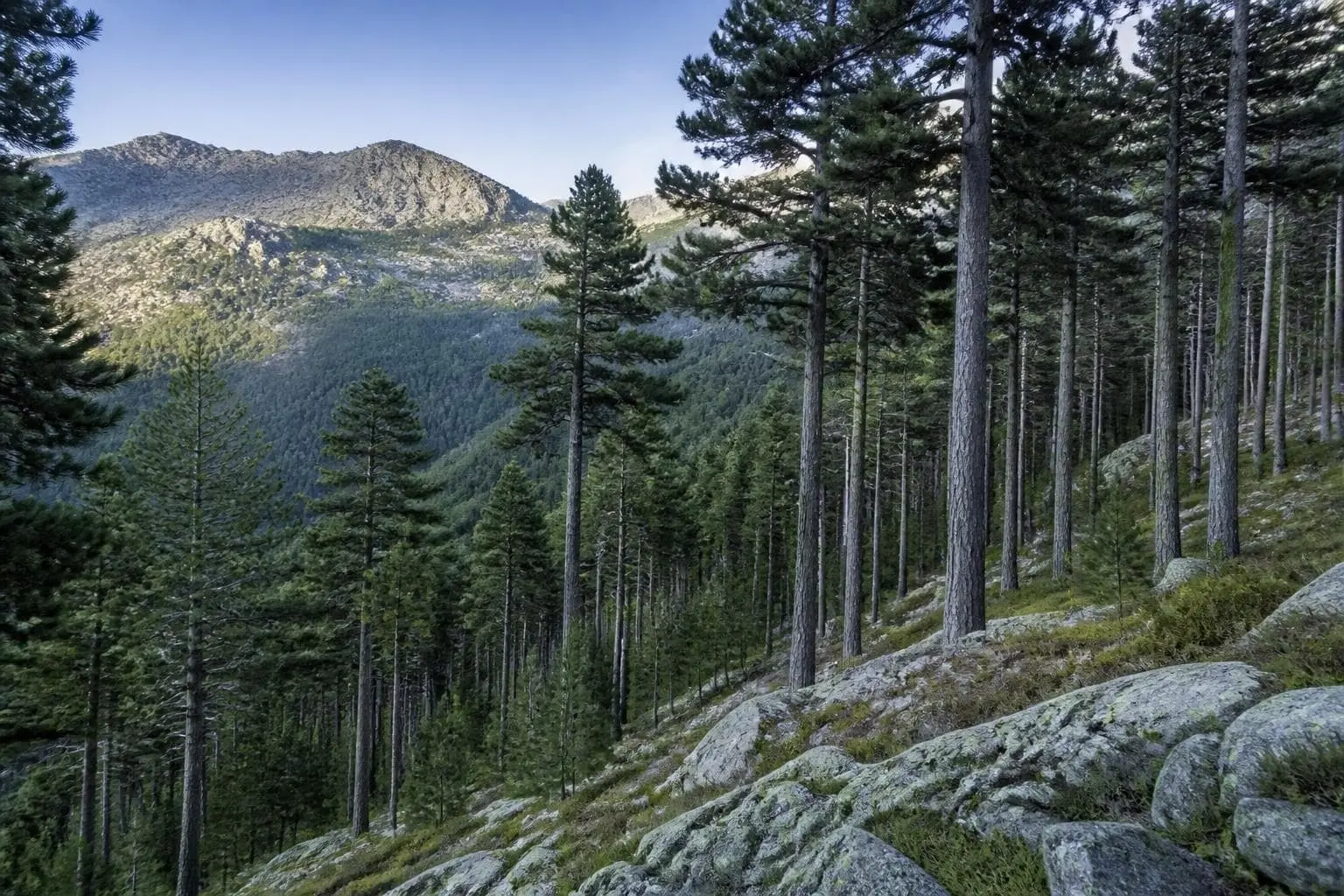
What Is Macedonian Pine and Where Does It Grow?
Macedonian pine (Pinus peuce), also called Balkan pine, is a mountain conifer found naturally only in the southern Balkans, and Bulgaria holds most of it (Alexandrov & Andonovski, 2011; Royal Botanic Garden Edinburgh, n.d.). Grisebach found it on Mount Pelister, in today’s North Macedonia, in 1839 and described it in 1844 (Alexandrov & Andonovski, 2011). It is the only member of the pine subgenus Strobus native to the Balkans (Alexandrov & Andonovski, 2011).
Its range falls into two parts divided by the Vardar valley. The eastern part lies in south-western Bulgaria. The western part spans North Macedonia, south-western Serbia, south-eastern Montenegro, eastern Albania and north-western Greece (Alexandrov & Andonovski, 2011).
Across that range the species occupies about 20,000 ha, just over 14,000 ha of it in Bulgaria (Royal Botanic Garden Edinburgh, n.d.), almost all of it in Pirin and Rila (Alexandrov & Andonovski, 2011).
It is a high-mountain tree, found naturally from 800–900 m up to 2,300–2,400 m, with an optimum between 1,600 and 1,900 m (Alexandrov & Andonovski, 2011). In Bulgaria, stands where it dominates lie mostly between about 1,800 and 2,200 m (Roussakova, 2011).
In Bulgaria, none of these forests is untouched by people. The Red Data Book states that fires and logging have destroyed parts of the species’ area, that the process continues and that no stands unaffected by human activity remain (Roussakova, 2011). That history matters for growth models, because tables built from managed or disturbed stands describe those stands, not a pristine forest.
How Do Foresters Predict the Growth of a Stand?
Bulgarian foresters have long predicted stand growth with growth and yield tables, which set out mean height, diameter, basal area and timber volume by age for stands of different site index (Mihov & Tonchev, 2010). The ’Analysis of a stand’ method is an original Bulgarian way of producing such tables. Duhovnikov proposed it in 1966 and 1971, refined it in 1979–1980 and described it in detail with Mihov in 1983 (Mihov & Tonchev, 2010).
The method works backwards. It takes the main characteristics of a stand at a mature age, usually 100 years, and reconstructs their values for earlier ages down to 20 years (Mihov & Tonchev, 2010). A stand growth model makes that possible, and it is normally fitted to repeated measurements from permanent sample plots on sites of different quality (Mihov & Tonchev, 2010).
One model per species
Before 2010, Bulgarian models of this kind covered Scots pine, Norway spruce, silver fir, oak, and both high-stem and coppice beech, and some had already fed into forestry projects (Mihov & Tonchev, 2010).
The authors call the method quick, since a model can be developed from 60–100 sample plots, and “rather objective”, and say it can yield tables for stands growing faster or slower than average (Mihov & Tonchev, 2010).
How Was the 2010 Model Built?
The model was built without new field measurements. Long-term monitoring data from permanent plots in natural Macedonian pine stands did not exist, so Mihov and Tonchev reworked the growth and yield tables published by Nedyalkov and Krastanov in 1962 (Mihov & Tonchev, 2010). They justified this by supposing that earlier table-makers had used sound methods (Mihov & Tonchev, 2010).
Height growth of a mean sample tree was reconstructed for each site index from its values at 100 years, with diameter growth worked out first so that jumps caused by mortality could be allowed for (Mihov & Tonchev, 2010). Height then came from a uniform height–diameter curve (Mihov & Tonchev, 2010).
The final formulas cover mean height, top height (the mean of the 100 thickest trees per hectare), mean diameter, basal area and stem volume (Mihov & Tonchev, 2010). Each scales a stand’s own value at 100 years by an age-dependent factor and by an ’average normal number’ from a table the authors treat as an obligatory part of the model (Mihov & Tonchev, 2010).
Conditions for using the model
The authors set strict conditions: stands over 100 years old, pure, even-aged, healthy and not understocked, with plots of at least 150–200 trees and felled mean sample trees for stem analysis (Mihov & Tonchev, 2010).
What Does the Model Say About How Fast Stands Grow?
The model expresses growth as a share of what a stand reaches at 100 years, not in absolute units. On its average curve, mean height at 20 years is 0.310 of the age-100 value, mean diameter 0.208 and stem volume only 0.140 (Mihov & Tonchev, 2010). By 50 years those shares have risen to 0.661, 0.531 and 0.528 (Mihov & Tonchev, 2010).
Volume lags furthest behind early on, because it depends on diameter and height growth together: at 20 years a stand has about a third of its age-100 height but only a seventh of its volume (Mihov & Tonchev, 2010).
Growth goes on after 100 years but gains less. Between 50 and 100 years the volume share rises from 0.528 to 1.000; in the next 40 years it reaches only 1.210 (Mihov & Tonchev, 2010). Stands on better or poorer sites shift these curves through their coefficients, which is how the model handles site quality (Mihov & Tonchev, 2010).
Why the model gives no cubic metres
Every formula needs a stand’s own value at 100 years as input (Mihov & Tonchev, 2010). The model therefore reconstructs the path a particular stand took, but it cannot say on its own how many cubic metres a Bulgarian Macedonian pine forest produces. That depends on measurements in real stands, which is exactly the data the authors lacked (Mihov & Tonchev, 2010).
Absolute productivity figures exist only from British trials, where yield classes of 4–14 m³ per hectare per year have been suggested, under conditions very different from Rila or Pirin (Savill & Mason, 2015).
How Reliable Are the Model’s Numbers?
The paper gives no way to judge its accuracy: it reports no fit statistics and no test against independent data, and its input is the 1962 tables rather than measured trees (Mihov & Tonchev, 2010). Its printed tables also contain apparent inconsistencies.
In Table 2 the two coefficients of equations 3 and 9 appear to be labelled the wrong way round. Read literally, the formula would put mean height at 100 years at more than 122 times its age-100 value; with the labels reversed, the age-dependent factor equals exactly 1 at 100 years on every site index (Mihov & Tonchev, 2010).
A growth model is only as current as the data behind it, and this one looks back to tables drawn up in 1962.
None of this proves the model wrong in practice, and the problems may be typographical (Mihov & Tonchev, 2010). Anyone applying the final formulas should first check them against the coefficients in the paper’s Table 2.
Is Macedonian Pine Threatened?
Macedonian pine is listed as Near Threatened on the global IUCN Red List (Farjon, 2017). Its subpopulations are small, scattered and isolated, and its area of occupancy, about 20,000 ha, is below the threshold for Vulnerable (Royal Botanic Garden Edinburgh, n.d.). It is unclear whether decline continues, or whether a recent expansion upslope will last (Royal Botanic Garden Edinburgh, n.d.).
Its status is worse within the EU. The 2019 European Red List of Trees assesses it as Near Threatened in Europe but Vulnerable in the EU28, where it grows only in northern Greece and western Bulgaria (Rivers et al., 2019). Bulgaria’s Red Data Book lists Macedonian pine forests (habitat 38G3) as Endangered, a rating for the forest habitat rather than the species (Roussakova, 2011).
Protection in Bulgaria
Large parts of the habitat lie within Rila, Pirin and Central Balkan National Parks and in Natura 2000 sites, and it is listed in Annex 1 of Bulgaria’s Biodiversity Act (Roussakova, 2011). Pirin National Park has been a World Heritage site since 1983, with boundaries extended in 2010 to 38,350 ha (UNESCO World Heritage Centre, n.d.). UNESCO notes many old-growth trees among its natural Macedonian and Bosnian pine forests (UNESCO World Heritage Centre, n.d.).
Protection does not remove pressure. UNESCO lists illegal logging, poaching, snowmobiles and quad bikes as threats to Pirin (UNESCO World Heritage Centre, n.d.). Ski areas developed at Bansko, Dobrinishte and Kulinoto in the 1980s and 1990s lie outside the 2010 boundaries but press on the property (UNESCO World Heritage Centre, n.d.).
The picture in Greece
Greece holds the rest of the EU population (Rivers et al., 2019), and there the habitat type that includes its forests (95A0) is rated Inadequate–Bad; a 2026 tree-ring study of two Greek stands found trees up to 104 years old, while Macedonian pine in Pirin can reach about 600 years (Christopoulou et al., 2026).
Do Old Yield Tables Still Hold in a Warming Climate?
There is no published test of the 1962 tables or the 2010 model against recent growth, but tree-ring studies show that the species responds to climate. In Pirin, three long treeline chronologies, the longest 675 years, show growth held back by cold winters (Zafirov et al., 2020).
Beetles, storms and felling
In 2020–2021, researchers reared three bark beetle species from snow-damaged branches of Macedonian pine in Pirin, Ips amitinus making up 75.2% of the 105 insects (Belilov et al., 2021). Across Bulgaria, conifer-stocked area fell by 7,006 ha in 2024, mainly after bark-beetle fellings and the drying of pine plantations, but the forest agency gives no figure for Macedonian pine (Executive Forest Agency, 2025).
The forest agency attributes that fall mainly to fellings after bark-beetle attack, mass drying of pine plantations outside their natural range and a policy of converting those plantations (Executive Forest Agency, 2025). Sanitary and salvage fellings covered 20,193 ha that year, 82% of it in conifer forests (Executive Forest Agency, 2025). The report gives no figure for Macedonian pine (Executive Forest Agency, 2025).
From tables to dynamic models
Newer approaches start from field measurements rather than old tables. A 2016 whole-stand model by Stankova, tested with data from 79 permanent plots in Scots pine plantations, was offered as an alternative to yield tables tied to a standard production regime (Stankova, 2016). In Pelister National Park, a 2023 study used 48 plots to compare 40 height–diameter models for Macedonian pine, a narrower tool than a growth model (Tanovski et al., 2023).
Remote sensing could supply more data: a 2016 review called airborne laser scanning transformative for forest inventories (White et al., 2016), and in May 2024 Bulgaria’s forest agency sought Swiss guidance on starting a National Forest Inventory (Executive Forest Agency, 2025).
Frequently asked questions
What is Macedonian pine?
Macedonian or Balkan pine (Pinus peuce) is a mountain conifer native only to the southern Balkans, from south-western Bulgaria to Albania and northern Greece (Alexandrov & Andonovski, 2011). It covers roughly 20,000 ha, just over 14,000 of them in Bulgaria (Royal Botanic Garden Edinburgh, n.d.), and is listed as Near Threatened (Farjon, 2017).
What data is the Macedonian pine growth model based on?
Mostly on old yield tables. With no long-term plot data for natural stands, the 2010 Bulgarian model was derived from growth and yield tables published in 1962 (Mihov & Tonchev, 2010). Field measurements come in only when the model is applied: sample trees in a stand older than 100 years are felled and analysed (Mihov & Tonchev, 2010).
Why does the model start from age 100?
The ’Analysis of a stand’ method takes a stand’s values at a mature age, usually 100 years, and reconstructs its earlier growth from them (Mihov & Tonchev, 2010). The authors describe 100 years as the preferred reference age for high-stem stands, and they require stands used with the model to be older than that (Mihov & Tonchev, 2010).
How accurate is the Bulgarian growth model for Macedonian pine?
Its accuracy is unknown. The 2010 paper reports no fit statistics and no test against independent data, and it rests on tables from 1962 (Mihov & Tonchev, 2010). Its printed coefficient table also shows apparent problems, such as labels that seem reversed, so the formulas should be checked against that table before use (Mihov & Tonchev, 2010).
Is climate change affecting Macedonian pine?
Tree rings from Pirin show cold winters limiting its growth, with signs of drought stress on some steep slopes in hot summers (Zafirov et al., 2020). Its altitudinal range has been rising (Royal Botanic Garden Edinburgh, n.d.), and remote Greek stands face growing wildfire risk (Christopoulou et al., 2026).
Sources
- Mihov, I., & Tonchev, T. (2010). Growth model for Macedonian pine (Pinus peuce Griseb.) stands in Bulgaria. Silva Balcanica, 11(1), 59–66. – Cabdirect archive record 20113129231
- Alexandrov, A. H., & Andonovski, V. (2011). EUFORGEN Technical Guidelines for genetic conservation and use of Macedonian pine (Pinus peuce). Bioversity International.
- Royal Botanic Garden Edinburgh. (n.d.). Pinus peuce. Threatened Conifers of the World.
- Farjon, A. (2017). Pinus peuce. The IUCN Red List of Threatened Species 2017: e.T34193A95751594.
- Rivers, M. C., Beech, E., Bazos, I., et al. (2019). European Red List of Trees. IUCN.
- Roussakova, V. (2011). 38G3 Macedonian pine (Pinus peuce) forests. In Red Data Book of the Republic of Bulgaria, Vol. 3: Natural habitats (digital edition). Bulgarian Academy of Sciences & Ministry of Environment and Water.
- UNESCO World Heritage Centre. (n.d.). Pirin National Park.
- Christopoulou, A., Lasut-Zmudzka, D., Zikos, A., Chrysafis, I., Kapsomenakis, I., Paidi, C., Ntagkounakis, G., Zevgolis, Y. G., Zerefos, C., & Arianoutsou, M. (2026). Revealing the ecology of Pinus peuce forests in Greece through tree rings forest dynamics and plant diversity. Discover Conservation, 3, 31.
- Zafirov, N., Panayotov, M., Tsvetanov, N., Nikolchova, I., & Trouet, V. (2020). Dendroclimatic analysis of Pinus peuce Griseb. at subalpine and treeline locations in Pirin Mountains, Bulgaria. Dendrochronologia, 61, 125703.
- Belilov, S., Georgiev, G., Mirchev, P., & Georgieva, M. (2021). Three species of bark beetles (Coleoptera: Curculionidae, Scolytinae) on Pinus peuce in Pirin Mountains in Bulgaria. Silva Balcanica, 22(2), 69–72.
- Executive Forest Agency. (2025). Annual report of the Executive Forest Agency for 2024 (in Bulgarian). Sofia.
- Stankova, T. V. (2016). A dynamic whole-stand growth model, derived from allometric relationships. Silva Fennica, 50(1), 1406.
- Tanovski, V., Matović, B., Risteski, M., & Trajkov, P. (2023). Modelling the tree height-diameter relationship of Macedonian pine (Pinus peuce Gris.) forests in North Macedonia. Journal of Forest Science, 69(11), 497–513.
- White, J. C., Coops, N. C., Wulder, M. A., Vastaranta, M., Hilker, T., & Tompalski, P. (2016). Remote sensing technologies for enhancing forest inventories: A review. Canadian Journal of Remote Sensing, 42(5), 619–641.
- Savill, P., & Mason, B. (2015). Pinus peuce Griseb., Macedonian or Balkan pine. Quarterly Journal of Forestry, 109(4), 245–252.

Marcus Reed — author
Marcus Reed writes with an editorial focus on statistics and quantitative research, including effect sizes, regression models, uncertainty, associations and the numerical results reported in scientific studies. At Cabdirect, Marcus covers quantitative findings...
Related

Chinese tourism research: questionnaire barriers in Kanas

Self-Rated Health and Education: Findings from 69 Countries

How Accurate Are Self-Reported Recreation Participation Rates?

Rapid Detection Methods for Genetically Modified Agricultural Products

Equine Anatomy and Clinical Examination in the 2010 Third Edition

Athletes accused of sexual assault: arrests and convictions