













Lab-grown meat and how cultivated meat is made from animal cells
Shafi et al. (2026) and Bakhsh et al. (2025) describe cultivated meat as animal-derived tissue produced from animal cells in culture. FDA, USDA and Singapore documents show that small-scale commercial pathways already exist, but Lynch and Pierrehumbert (2019) and Humbird (2021) show that the strongest claims about climate and cost still depend on electricity supply and scale-up.
The sections below explain where the cells come from, how cell banking, growth media, bioreactors and scaffolds fit together, and where products have reached the market. They also separate direct observations from model-based scenarios.
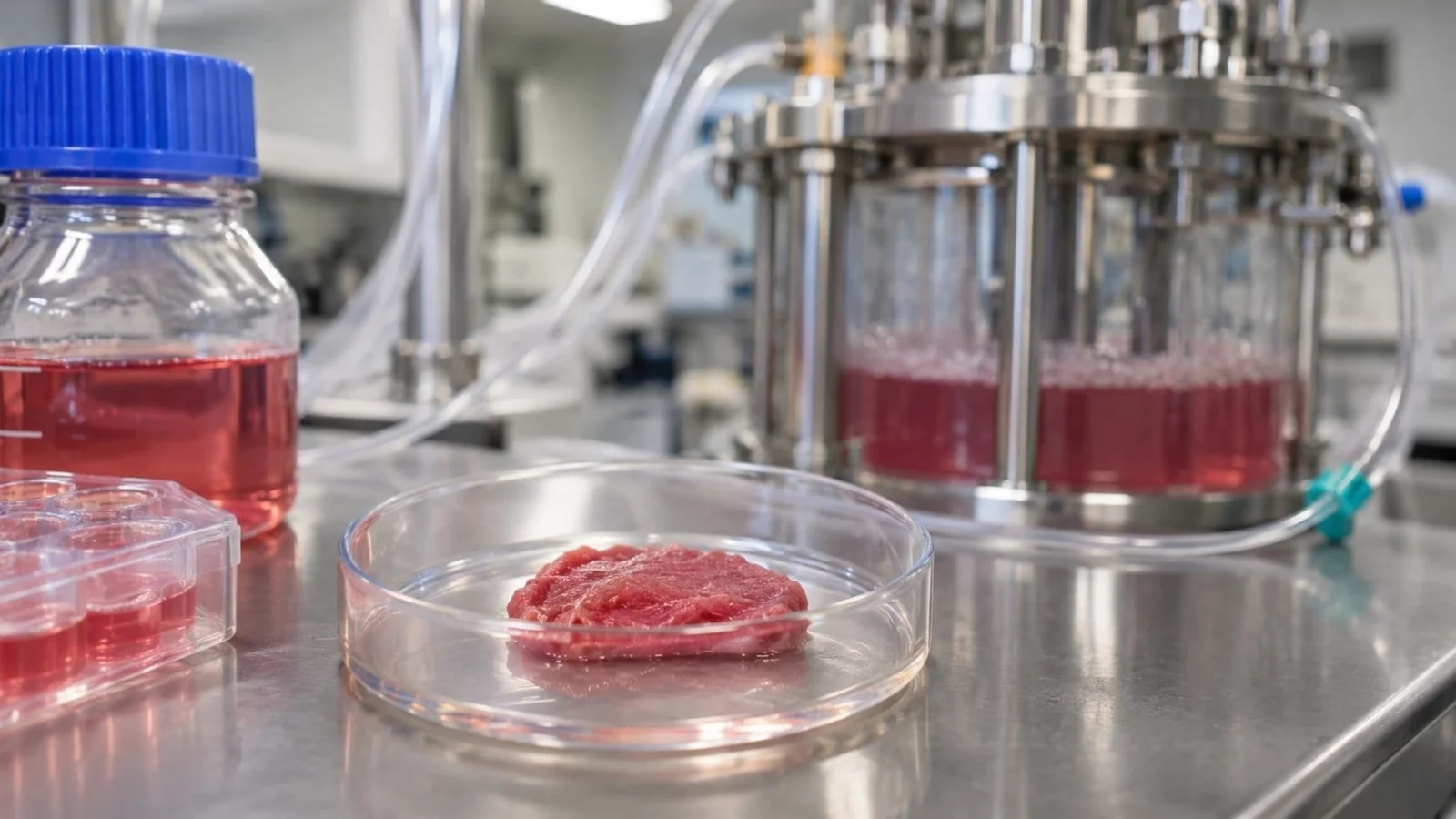
What lab grown meat is and where its cells come from
Cultivated meat starts with animal cells, not with plant proteins. Allan et al. (2019) write that the cell source can be primary cells isolated from tissue or immortalised cell lines. Shafi et al. (2026) frame the goal as producing animal-derived protein without raising whole animals for each batch.
Animal cells and conventional meat
Conventional meat is muscle and fat tissue taken from an animal after rearing and slaughter. In the 2022 UPSIDE Foods consultation, regulators stated that the firm would take living chicken cells and grow them in a controlled environment to make cultured food.
Allan et al. (2019) add that the initial cells may come from primary tissue samples or from immortalised lines. In the same review, Allan et al. (2019) note that stem-like cells such as myoblasts, satellite cells and induced pluripotent stem cells are attractive because they proliferate readily before differentiation.
The choice of cell matters because a production system needs both growth and stability. In a 2022 UPSIDE Foods consultation, regulators said the evaluation covered the establishment of cell lines and cell banks, manufacturing controls and the inputs used in the process.
Cultivated meat and plant-based alternatives
Cultivated meat differs from a plant-based analogue because the biomass is built from animal cells. Allan et al. (2019) show that producers choose the target product form at the start of process design, whether that target is processed meat, a whole cut or another protein format.
That design choice helps explain why early products have tended to be simpler. Shafi et al. (2026) write that desirable texture, flavour, nutritional quality and economic viability remain challenging at large scale, so whole cuts are a harder target than processed products.
The contrast with other biotechnology fields is also useful. Food-biotechnology oversight often depends on the exact organism, ingredients and method used, which is one reason rapid detection methods for genetically modified agricultural products focus on process-specific identification. The Singapore Food Agency's 2023 guidance says cultivated-meat safety assessments are specific to the materials and manufacturing processes used by each company.
How cultivated meat is made from animal cells
The production line has several linked stages, and each stage affects the next. Allan et al. (2019) describe a system that needs expanding cells, supplying media, guiding differentiation and deciding how the final biomass will be turned into food.
Cell selection and cell banking
Cell selection comes first because the whole process depends on the biology of the starting material. In a 2022 UPSIDE Foods consultation, regulators said the evaluation included cell lines and cell banks.
A cell bank turns a small biological sample into a reusable manufacturing platform. Allan et al. (2019) show why that matters: the cells chosen for production have to proliferate well enough to support the biomass-expansion stage.
The laboratory discipline behind cell banking is familiar from other areas of bioscience. For readers who want a broader view of why reproducible handling matters in cell-based work, the Molecular Cloning manual is a useful example of how laboratories standardise biological material and methods.
Growth media and bioreactors
After the cells are chosen, they are grown in culture media that supply nutrients and other required components. Allan et al. (2019) write that media demand can be estimated from reactor volume or from what the cells actually consume, and they prefer the consumption-based approach because it is better at preventing substrate limitation.
The cells also need a bioreactor, which is a vessel that controls the culture environment. Allan et al. (2019) write that large-scale production usually favours fed-batch or continuous media supply.
Bioreactors are common in biotechnology. Allan et al. (2019) explain that the myocyte precursors used for cultivated meat are anchorage-dependent and have low shear tolerance, so hydrodynamic forces can damage cells or detach them from their surface.
Cell differentiation and edible scaffolds
Growth alone does not make meat-like tissue. Allan et al. (2019) describe proliferation and differentiation as the two sequential culture phases that structure the whole bioprocess.
Differentiation is where cells begin to take on more tissue-specific roles, and scaffold choice becomes central. Allan et al. (2019) write that scaffold design affects reactor size, seeding efficiency, downstream processing and cost.
That link between scaffold design and product structure helps explain why thick whole cuts are difficult. Shafi et al. (2026) state that desirable texture and economic viability remain challenging at large scale, so the engineering problem also includes building structure and controlling cost.
Harvesting and food processing
Once the biomass has been expanded and differentiated, it has to be harvested and handled as food. Allan et al. (2019) note that the chosen product form changes the downstream process, so a processed product and a structured cut will not pass through the same manufacturing route.
The factory therefore combines cell culture with food processing. Allan et al. (2019) add that quality assurance has to monitor cell state, including cell viability, phenotype and protein content, throughout the process.
At this point the bottleneck is no longer only biological. Shafi et al. (2026) say that large-scale production still has to deliver texture, flavour, nutritional quality and economic viability together.
Where cultivated meat is produced and sold
Cultivated meat is already regulated and sold in limited settings. Sales and approvals remain concentrated in a small number of companies and venues.
Minced products and structured cuts
Early products have mostly been processed forms. Allan et al. (2019) show why by placing the choice between processed and full-cut meat at the start of process design.
The technical reason is structural. Allan et al. (2019) say scaffold choice affects downstream handling, and Shafi et al. (2026) say that large-scale production with good texture remains difficult.
That does not rule out structured products in the future. It means that the first commercial steps are more likely to come from formats that tolerate mixing, shaping or blending while whole cuts remain harder to scale cleanly.
Regulatory approvals and commercial examples
The first clear commercial milestone came in Singapore. The Ministry of Sustainability and the Environment said in 2020 that the Singapore Food Agency had approved the sale of Eat Just's chicken bites and that Singapore was the first country to approve sale of lab-grown meat.
The United States followed with a staged route. The 2022 UPSIDE Foods consultation update said the agency had completed a first pre-market consultation for the company. The 2023 GOOD Meat notice said the agency had completed a second consultation, and the same notice states that USDA inspection and a USDA mark of inspection were still required before market entry.
The FDA inventory gives the clearest snapshot of the U.S. pipeline. The FDA inventory for February 2026 listed five completed consultations: cultivated chicken from Believer Meats, UPSIDE Foods and GOOD Meat, cultivated pork fat from Mission Barns, and cultivated salmon from Wildtype.
Retail availability remains narrow. USDA FSIS stated in its 2025 Explanatory Notes that cultured animal-cell foods were not yet available in retail stores, while the Good Food Institute (2026) subsequently documented a limited U.S. grocery-store sale by Mission Barns in November 2025.
Labelling is part of the same regulatory picture. The Singapore Food Agency's 2023 guidance says pre-packed products should use qualifying terms such as cultured or cell-based and should not be misrepresented as conventional meat.
Potential benefits of lab-grown meat for animals and resource use
The benefit claims around cultivated meat fall into separate groups. Animal welfare is discussed in reviews, while land and water claims come mainly from environmental models.
Animal welfare and livestock demand
The welfare case rests on substitution. Shafi et al. (2026) describe cultivated meat as a way to produce animal-derived protein without large-scale animal rearing and slaughter.
That sentence describes a potential effect, not a measured market outcome. The effect on livestock demand depends on adoption, and Shafi et al. (2026) also write that economic viability at scale remains difficult.
Bakhsh et al. (2025) still list animal welfare among the technology's expected advantages. That benefit would matter only if cultivated meat replaces some conventional meat demand.
Land and water requirements
The main quantitative claims about land and water come from life-cycle modelling. Tuomisto and Teixeira de Mattos (2011) estimated that producing 1000 kg of cultured meat would require 367–521 m3 of water and 190–230 m2 of land.
In the same model, Tuomisto and Teixeira de Mattos (2011) estimated about 99% lower land use and 82–96% lower water use than conventionally produced European meat, depending on the comparison product. The estimate shows why land and water are often presented as the strongest potential advantages.
Mattick et al. (2015) reached a similar broad view on land and agricultural inputs. Their anticipatory analysis also warned that some of those gains could come with higher energy demand. Similar trade-offs also appear in organic vs conventional farming.
What environmental studies show about cultivated meat
Environmental claims are the most sensitive to assumptions. The published evidence still comes mostly from scenario studies and climate-modelling work, not from many mature factories working at commercial scale.
Greenhouse gas emissions and electricity sources
Tuomisto and Teixeira de Mattos (2011) estimated 1900–2240 kg CO2-equivalent emissions and 26–33 GJ of energy for 1000 kg of cultured meat. The study treated those figures as part of a large-scale production model.
Tuomisto and Teixeira de Mattos (2011) also estimated 78–96% lower greenhouse-gas emissions than conventional European meat, while energy use was 7–45% lower and conventional poultry still had lower energy use in that comparison. The poultry exception shows that the advantage was not uniform across every comparison.
Mattick et al. (2015) argued that lower land and agricultural-input demand could come with more intensive energy use. In a climate-modelling study, Lynch and Pierrehumbert (2019) wrote that cattle systems emit methane as well as carbon dioxide and nitrous oxide, while cultivated-meat emissions are mostly carbon dioxide from energy generation, so the long-run balance depends on whether electricity becomes low-carbon.
Selected life cycle assessment studies
The studies do not disagree on every point. Tuomisto and Teixeira de Mattos (2011), Mattick et al. (2015) and the climate-modelling study by Lynch and Pierrehumbert (2019) all show that system boundaries and electricity assumptions shape the answer, which is why one headline number cannot settle the issue for every future production system.
Study | Scope and design | What was assessed | Main conclusion |
Tuomisto and Teixeira de Mattos, 2011 | Life-cycle model of large-scale cultured meat | Energy, land, water and GHG emissions | Estimated lower land, water and GHG burdens than conventional European meat under the model assumptions. |
Mattick et al., 2015 | Anticipatory U.S. life-cycle analysis | Land, agricultural inputs and energy implications | Suggested lower land and input demand than livestock, but with higher energy demand in some scenarios. |
Lynch and Pierrehumbert, 2019 | Climate modelling study | Long-run climate effects of cultured meat and cattle | Found that cultured meat is not automatically climatically superior and depends on decarbonised energy. |
Humbird, 2021 | Techno-economic analysis | Process conditions linked to scale and cost | Found that low-cost media and efficiency gains are necessary but insufficient for displacement of conventional meat. |
Food safety and production challenges of cultivated meat
The hardest problems now sit between biology, manufacturing and regulation. A cultivated-meat plant has to keep cells growing, keep hazards under control and still reach a viable cost.
Microbial contamination and chemical hazards
Bakhsh et al. (2025) write that successful commercialisation depends on dealing with biological, chemical and nutritional safety as well as regulation. The review therefore treats regulation as part of commercial feasibility.
The Singapore Food Agency sets out the safety file in more detail. Its 2023 guidance says the dossier should include the identity, genetic stability and purity of the cell culture, the identity and purity of inputs such as media components and scaffolding materials, and any hazards that may arise during manufacture.
Section 3.10 of the Singapore Food Agency's 2023 guidance applies when genetically modified organisms are used in novel food production. It calls for genome analysis to assess virulence-related genes, antibiotic resistance and potentially harmful metabolic activity, including toxin production.
Because the system is product-specific, one company's clearance does not automatically generalise to another. The Singapore Food Agency's 2023 guidance says safety assessments are specific to the materials and manufacturing processes described in each application.
Production costs and bioreactor scale-up
Allan et al. (2019) identify a major engineering constraint in the cells themselves. Their review says the precursor cells used for cultivated meat are anchorage-dependent and have low shear tolerance, so the flow conditions inside a reactor can damage cells or detach them from their surface.
Humbird's 2021 techno-economic analysis reaches the same bottleneck from a different angle. Humbird (2021) concludes that higher metabolic efficiency and low-cost media made from plant hydrolysates are necessary but insufficient if cultivated meat is to displace conventional meat.
Quality assurance also covers the state of the cultured cells. Allan et al. (2019) identify cell viability, phenotype and protein content as parameters to monitor during production.
What is proven about cultivated meat and what is not
Some parts of the story are already factual, while others still rest on models or on early industrial assumptions. Regulatory approvals and restaurant sales are observations, while climate superiority, cheap mass retail and broad nutritional equivalence are still conditional claims.
In a climate-modelling study, Lynch and Pierrehumbert (2019) showed that climate advantage depends on the energy system. USDA FSIS (2025), Shafi et al. (2026) and Humbird (2021) show that retail reach, product quality and price competitiveness still depend on scale-up.
What is established is that cultivated meat can be produced as real animal-cell food and can pass through a regulatory route. The Ministry of Sustainability and the Environment reported Singapore's approval of Eat Just's chicken bites in 2020. The FDA inventory for February 2026 listed five completed consultations.
What still depends on conditions is the size of the environmental and economic advantage. Tuomisto and Teixeira de Mattos (2011) estimated large land and water savings. Mattick et al. (2015) and, in a climate-modelling study, Lynch and Pierrehumbert (2019) show that energy use and electricity supply can change the climate picture. Humbird (2021) adds that cheaper media and better efficiency are still not enough on their own to secure displacement of conventional meat.
What is not established is broader. No evidence shows that every cultivated product will match conventional meat in nutrition, texture, price and retail availability. Shafi et al. (2026) say large-scale production with desirable texture, flavour, nutritional quality and economic viability remains challenging.
The next useful evidence should come from commercial plants that disclose measured energy use, contamination control, cost and final product composition. That kind of evidence would test whether the best-case scenarios from current models survive real industrial conditions.
Frequently asked questions
Is lab-grown meat suitable for vegetarians or vegans?
Usually not, although some vegetarians may disagree. Allan et al. (2019) say cultivated meat is made from animal cells. The Singapore Food Agency's 2023 guidance says product assessment also covers media components and scaffolding materials. Whether a vegetarian accepts it is therefore an ethical judgement, not a settled scientific category.
Is lab-grown meat halal or kosher?
Halal or kosher status depends on the product and the relevant religious authority. FAO and WHO (2023) describe how the origin of the cells and the composition of the culture medium may affect religious acceptance. Their report also notes differing religious interpretations of whether particular cultivated meat products are permissible.
Is the nutritional value of cultivated meat the same as conventional meat?
Not automatically. Bakhsh et al. (2025) include nutritional safety among the core commercialisation questions. Shafi et al. (2026) say large-scale production with desirable nutritional quality is still challenging. A cultivated product may be designed to resemble conventional meat, but the evidence does not justify assuming equivalence across all products.
How will cultivated meat be labelled?
The Singapore Food Agency's 2023 guidance calls for qualifying terms such as cultured or cell-based on pre-packed products. The 2023 GOOD Meat notice describes USDA oversight for cultivated chicken. FAO and WHO (2023) explain that FDA oversees labelling for most cultivated seafood, except fish of the order Siluriformes, which fall under USDA jurisdiction.
Is cultivated meat production energy intensive?
It can be. Tuomisto and Teixeira de Mattos (2011) estimated 26–33 GJ of energy for 1000 kg of cultured meat. Mattick et al. (2015) warned that lower land demand could still come with higher energy use. In a climate-modelling study, Lynch and Pierrehumbert (2019) linked long-run climate performance to decarbonised electricity.
Sources
- Allan et al. Bioprocess Design Considerations for Cultured Meat Production With a Focus on the Expansion Bioreactor. Frontiers in Sustainable Food Systems. 2019;3:44. DOI: 10.3389/fsufs.2019.00044.
- Tuomisto and Teixeira de Mattos. Environmental impacts of cultured meat production. Environmental Science & Technology. 2011;45(14):6117–6123. DOI: 10.1021/es200130u.
- Mattick et al. Anticipatory Life Cycle Analysis of In Vitro Biomass Cultivation for Cultured Meat Production in the United States. Environmental Science & Technology. 2015;49(19):11941–11949. DOI: 10.1021/acs.est.5b01614.
- Lynch and Pierrehumbert. Climate impacts of cultured meat and beef cattle. Frontiers in Sustainable Food Systems. 2019;3:5. DOI: 10.3389/fsufs.2019.00005.
- Humbird D. Scale-up economics for cultured meat. Biotechnology and Bioengineering. 2021;118(8):3239–3250. DOI: 10.1002/bit.27848.
- U.S. Food and Drug Administration. FDA Completes First Pre-Market Consultation for Human Food Made Using Animal Cell Culture Technology. 16 November 2022. https://www.fda.gov/food/hfp-constituent-updates/fda-completes-first-pre-market-consultation-human-food-made-using-animal-cell-culture-technology
- U.S. Food and Drug Administration. FDA Completes Second Pre-Market Consultation for Human Food Made Using Animal Cell Culture Technology. 21 March 2023. https://www.fda.gov/food/fda-updates-food/fda-completes-second-pre-market-consultation-human-food-made-using-animal-cell-culture-technology
- U.S. Food and Drug Administration. Human Food Made with Cultured Animal Cells Inventory. 19 February 2026. https://www.hfpappexternal.fda.gov/scripts/fdcc/?set=AnimalCellCultureFoods
- Ministry of Sustainability and the Environment, Singapore. Climate Action in SG (Dec 2020). 2020. URL: https://www.mse.gov.sg/latest-news/newsletter-climate-action-in-sg-dec/.
- Singapore Food Agency. Requirements for the Safety Assessment of Novel Foods and Novel Food Ingredients. 20 July 2023. URL: https://www.sfa.gov.sg/docs/default-source/regulatory-standards-frameworks-and-guidelines/requirements-for-the-safety-assessment-of-novel-foods-and-novel-food-ingredients.pdf.
- U.S. Department of Agriculture FSIS. 2025 USDA Explanatory Notes. 2025. URL: https://www.usda.gov/sites/default/files/documents/24-FSIS-2025-ExNotes.pdf.
- Shafi et al. Advances in Cultivated Meat Technology for Sustainable Alternative Protein Production: A Review. Biotechnology and Bioengineering. 2026;0:e70347. DOI: 10.1002/bit.70347.
- Bakhsh et al. Cell-Based Meat Safety and Regulatory Approaches: A Comprehensive Review. Food Science of Animal Resources. 2025;45(1):145–164. DOI: 10.5851/kosfa.2024.e122.
- The Good Food Institute. 2026 State of the Industry Report: Cultivated Meat, Seafood, and Ingredients. 2026. URL: https://gfi.org/wp-content/uploads/2026/04/GFI_2026-State-of-the-Industry-report-Cultivated-meat-seafood-and-ingredients.pdf.
- Food and Agriculture Organization of the United Nations and World Health Organization. Food safety aspects of cell-based food. Rome: FAO; 2023. DOI: 10.4060/cc4855en.
Anjali Dhanjal — author
Anjali Dhanjal is a plant science specialist with a degree in Plant Science and a master’s-level specialization in Plant Breeding. Her earlier work involved preparing reviews of variety trials and crop genetics research for farmers, translating scientific find...
Related
Organic vs Conventional Farming: Economics and Ecology
Rapid Detection Methods for Genetically Modified Agricultural Products
The 1989 Molecular Cloning Manual: Why Labs Still Cite It
Hevea brasiliensis breeding: from crosses to field trials
What GMO means and what research shows about genetically modified food
The green revolution and how new crops changed farming
Glyphosate’s Rise to Top Weedkiller: A 1997 Account