














Vertical farming and what indoor farms can and cannot do
Vertical farming grows crops in stacked indoor layers under artificial light and controlled climate; it can raise land and water productivity for selected high-value crops, but it cannot escape high energy and capital costs or economically replace field farming for most staples. Its strongest use cases are therefore specific combinations of crop, location, market and energy system rather than a universal alternative to outdoor agriculture.
This article explains how indoor vertical farms control light, climate and root-zone conditions, which crops fit them, and what research shows about yield, water and energy use. It draws on peer-reviewed studies and reviews, USDA and Virginia Cooperative Extension material, plus official records of business closures and restructuring to separate technical capability from business viability.
Inside a vertical farm: light, climate and root-zone control
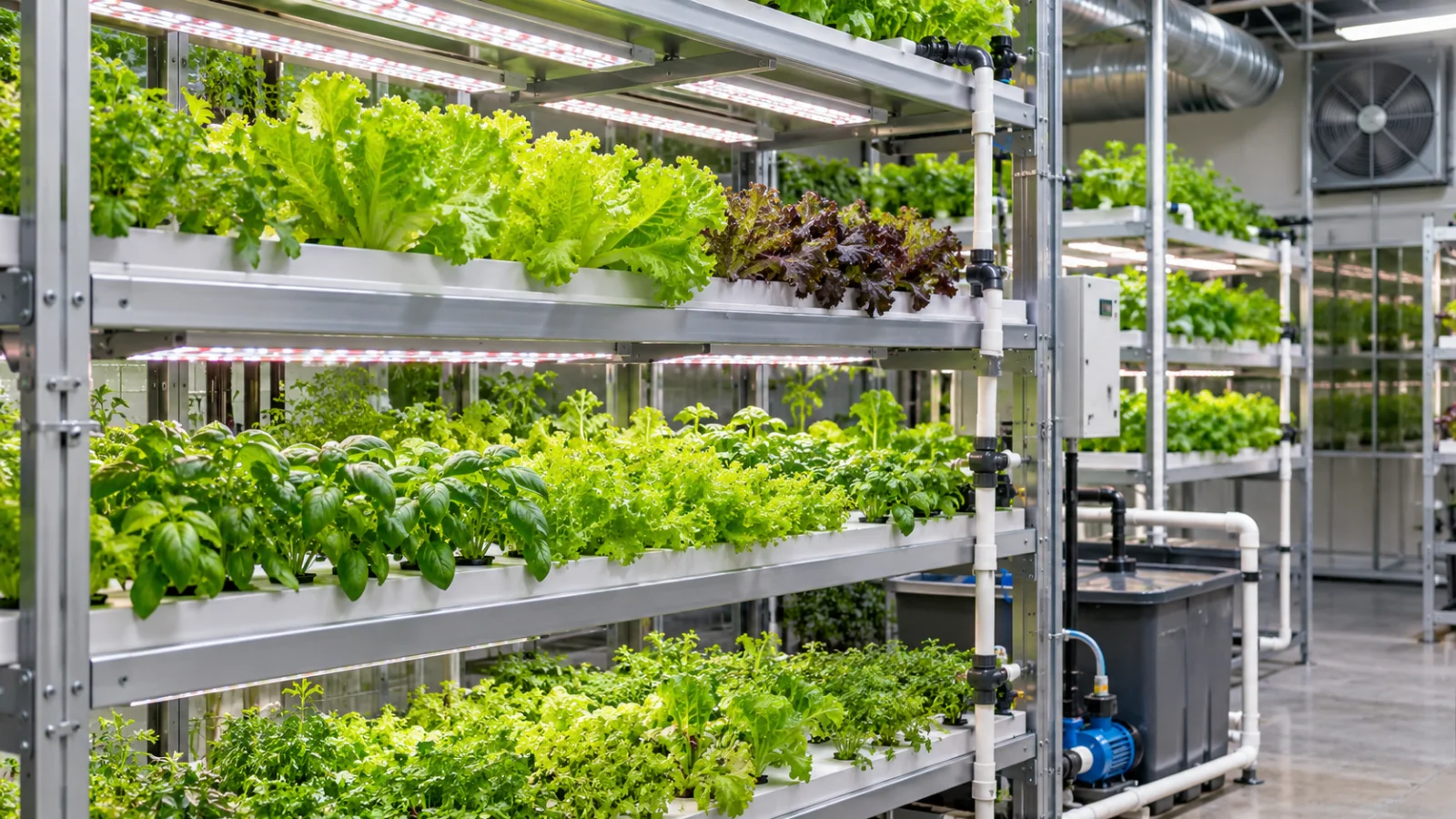
Vertical farming is a form of controlled-environment agriculture in which crops are arranged in stacked layers and the growing environment is managed largely independently of outdoor weather. Modern indoor vertical farms usually replace sunlight with electric lighting and combine it with controlled temperature, humidity, airflow, carbon dioxide, irrigation and nutrient delivery (van Delden et al., 2021; Doss and South, 2026). That makes the system closer to an engineered production facility than to a field, even though the biological limits are still set by the crop.
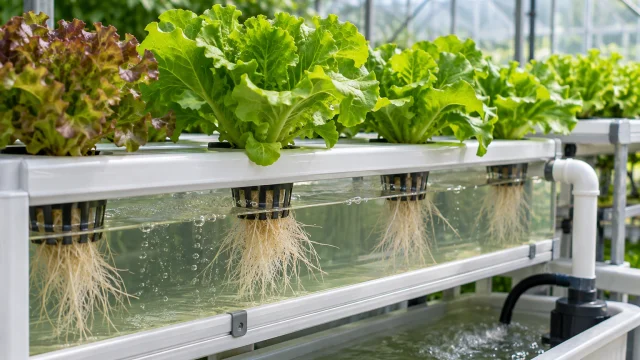
The crop root zone is commonly separated from field soil. Hydroponic systems circulate or periodically deliver nutrient solution around roots, while aeroponic systems expose roots to a nutrient-bearing mist or aerosol; Eldridge et al. (2020) describe aeroponics as a promising route for improving root oxygenation and nutrient delivery, while also stressing that important physiological and engineering questions remain unresolved. Recirculation can reduce losses of water and fertiliser, but it also means that pumps, sanitation, sensors and water chemistry become part of basic crop management.
Light and climate control are inseparable because electricity used by lamps ultimately becomes heat that must be managed. USDA Agricultural Research Service researchers describe artificial lighting and heating, ventilation and air conditioning as central cost and energy constraints in enclosed vertical farms (USDA Agricultural Research Service, 2021). This is why precision agriculture matters to vertical farming: sensors, automation and control software are not decorative additions but part of keeping light, moisture, temperature and nutrient conditions within a narrow operating range.
Why tighter control can also create tighter failure points
A closed farm removes much of the variability of rain, wind and seasonal temperature, but it replaces those uncertainties with dependence on engineered systems. Doss and South (2026) note that equipment failures, power interruptions and mistakes in environmental control can quickly affect crop health, while recirculating water requires sanitation because the same efficiency that conserves water can also move a problem through a connected system. Reliable production therefore depends on redundancy, monitoring and staff who understand both plants and equipment.
Automation can improve consistency, especially when large numbers of racks must be managed as one biological system. Van Delden et al. (2021) identify automation, robotics, system control and crop sensing as central research areas for scaling vertical farms, but scaling also creates integration problems that are less visible in small trials. A technically successful growth recipe has to keep working across lighting zones, airflow patterns, irrigation circuits, harvest schedules and cleaning cycles rather than only on a research bench.
Crop choice in stacked indoor farms
The crops that fit vertical farms best are generally compact, fast-growing and valuable enough to justify a highly controlled environment. Virginia Cooperative Extension lists leafy greens, herbs, microgreens and some compact fruiting crops among current commercial options, while noting that crop architecture, production time, labour demand and market value all affect suitability (Doss and South, 2026). USDA researchers likewise identify lettuce and other leafy greens as the most established category and note that cereal and row crops remain better suited to conventional farming (USDA Agricultural Research Service, 2021).
The reason is partly biological and partly economic. A crop that has a high harvest index, a short cycle and modest vertical height turns more of the farm's illuminated space into saleable product; a tall crop with a long season and large non-marketable biomass ties up lights and floor area for longer. Van Delden et al. (2021) therefore describe present vertical-farm output as concentrated in a limited range of fruits, vegetables and herbs rather than staple crops.
Crop choice can broaden as cultivars and systems improve, but technical feasibility is not the same as commercial fit. Strawberries and compact tomatoes can be grown indoors, yet fruiting crops generally demand more light and longer occupancy than leafy greens, which changes electricity and labour costs (Doss and South, 2026). The practical question is therefore not whether a plant can survive in a vertical farm, but whether its biology, selling price, quality requirements and production cycle make the controlled environment worth paying for.
Yield and water use in vertical farming
High output per unit of ground footprint is one of vertical farming's strongest advantages, because several crop layers occupy the same building footprint and production can continue across seasons. A frequently cited Arizona comparison by Barbosa et al. (2015) modelled hydroponic lettuce at 41 ± 6.1 kg per square metre per year against 3.9 ± 0.21 kg per square metre per year for conventional lettuce, an estimated 11 ± 1.7-fold difference. That result is useful for illustrating the land-productivity potential of protected hydroponics, but it was a modelled comparison of particular Arizona systems rather than a universal ratio for all vertical farms.
Water efficiency can also improve sharply when nutrient solution is captured and recirculated. In the same Barbosa et al. (2015) comparison, modelled water demand was 20 ± 3.8 litres per kilogram of lettuce for hydroponics and 250 ± 25 litres per kilogram for conventional production. Graamans et al. (2018), using climate and crop models to compare plant factories with greenhouses in several climates, found that plant factories could reduce water use by 28–95% depending on the greenhouse comparator, showing that the size of the advantage depends strongly on what the indoor farm is compared with.
The newer review by Pennisi et al. (2025) puts these single-study results into a broader context: mean reported lettuce yield was 59.7 ± 5.8 kg fresh weight per square metre per year across scientific literature data (n = 54) and 105.2 ± 15.2 kg across company-declared data (n = 32), while mean water-use efficiency was 140.7 ± 71.0 g fresh weight per litre of water (n = 88). Those figures are benchmarks drawn from heterogeneous studies, not promises for a new facility. The wider lesson matches the approach used in comparisons of farming systems: the conclusion changes when performance is expressed per unit of land, per kilogram of crop, per litre of water or per unit of energy.
Evidence source | System and comparator | Reported result | Main limitation |
Barbosa et al. (2015) | Modelled hydroponic greenhouse lettuce vs conventional lettuce in Arizona | Yield 41 ± 6.1 vs 3.9 ± 0.21 kg/m²/year; water 20 ± 3.8 vs 250 ± 25 L/kg | The hydroponic figures were theoretical/modelled for a specific setting |
Graamans et al. (2018) | Modelled plant factory vs greenhouses in several climates | Plant-factory water use lower by 28–95%; purchased electricity 247 kWh/kg dry weight vs 70–211 kWh/kg dry weight in greenhouse cases | Results depend on climate, greenhouse technology and dry-weight basis |
Pennisi et al. (2025) | Review of vertical-farm lettuce evidence | Mean lettuce yield 59.7 ± 5.8 kg fresh weight/m²/year in scientific literature data and 105.2 ± 15.2 kg in company-declared data; mean water-use efficiency 140.7 ± 71.0 g fresh weight/L | Review averages combine different facilities, cultivars and operating conditions |
Energy demand is the central trade-off
The water and land advantages do not remove the energy bill. Barbosa et al. (2015) estimated 90,000 ± 11,000 kJ of energy per kilogram for their hydroponic lettuce case against 1,100 ± 75 kJ per kilogram for conventional production, an 82 ± 11-fold difference, with heating and cooling dominating the hydroponic total. That study was not a modern multi-layer warehouse farm, but it captured the basic problem that remains: replacing free sunlight and outdoor heat exchange with electric light and mechanical climate control shifts the resource burden towards energy.
More recent vertical-farm studies show where that electricity goes. Arcasi et al. (2024) modelled a lettuce vertical farm and found lighting responsible for about 65–85% of energy demand across scenarios, with heating, ventilation and air conditioning accounting for about 10–20%; their energy-specific cost also varied materially with city, climate, lighting efficiency and electricity price. Keyvan and Roshandel (2024) similarly reported that lighting and dehumidification were the largest energy consumers in their integrated energy-yield-cost model, which estimated electricity consumption of 11.34 kWh per kilogram in a case study of vertical lettuce production.
Efficient lighting helps, but plant biology sets limits on how much harvested biomass can be produced from each photon. Jin et al. (2023) reviewed lettuce studies and found an average incident-light-use efficiency of 0.55 g dry weight per mole of photons in vertical farms, compared with 0.39 g in greenhouses and 0.23 g in open fields; the authors also reported very wide variation between experiments. Better fixtures, canopy design and crop management can therefore improve performance, but they cannot make the electricity input disappear.
Carbon performance depends on the electricity behind the farm
Energy use is also why claims about lower food miles do not automatically translate into a lower carbon footprint. Pennisi et al. (2025) report an average global-warming impact of about 2.9 kg carbon dioxide equivalent per kilogram of fresh-weight produce across the vertical-farming evidence they reviewed, while emphasising that outcomes change with the electricity mix and the comparator. A farm powered by a low-carbon grid can therefore look very different from an otherwise identical farm running on fossil-intensive electricity.
This dependence makes location more complicated than simply putting farms close to cities. Graamans et al. (2018) found that greenhouse and plant-factory resource performance changed across climates because greenhouses can exploit solar energy while also paying different heating or cooling penalties. Vertical farming can avoid the weather outside, but it cannot avoid the local cost and carbon intensity of the energy system that supplies the building.
Vertical farming can use land and water very efficiently, but it does so by buying control with electricity, equipment and capital. Its sustainability and economics therefore depend on the crop, the local energy system and the alternative production system being compared.
Profitability and business risks in vertical farming
Vertical farms can be profitable, but profitability is not a property of the technology by itself. Virginia Cooperative Extension identifies high start-up costs and high energy consumption as major challenges and says profitability depends on matching farm size, system design, crops and technology with market demand; it also notes that profitability varies with crop growth habits, market value and labour needs (Doss and South, 2026). Economic models make the same point from another direction: Arcasi et al. (2024) found that the energy cost of lettuce changed with climate and power prices, while Keyvan and Roshandel (2024) showed that changes in light, carbon dioxide and energy supply altered both yield and unit cost.
Corporate setbacks should not be mistaken for evidence that crops cannot be grown vertically. A New York State Department of Labor WARN notice records an economic closure at Bowery Farming's New York City site effective 1 November 2024, affecting 69 workers (New York State Department of Labor, 2024). Plenty filed for Chapter 11 restructuring in March 2025 and emerged in May 2025 with a narrower focus on strawberries, illustrating how financing and crop strategy can change even when an indoor-farming platform remains in use (Plenty, 2025a; Plenty, 2025b).
The 2025 review by Pennisi et al. links the sector's difficulties especially to high energy use and the energy-price shock after 2022, but it also notes that individual failures have involved different operational and managerial factors (Pennisi et al., 2025). The more defensible conclusion is that vertical farming has a narrow economic window rather than a single failure mechanism. Automated monitoring and operational data, similar in principle to the machine-data and dashboard control used in other precision-agriculture settings, may reduce waste and improve consistency, but automation cannot rescue a crop whose revenue does not cover capital, energy and labour.
What vertical farming has proved and what remains uncertain
The evidence supports several capabilities with reasonable confidence. Indoor vertical farms can decouple production from outdoor weather, raise annual output per unit of building footprint, recycle water and nutrients, and create tightly controlled conditions for high-value horticultural crops (van Delden et al., 2021; Pennisi et al., 2025). Hydroponic and aeroponic systems also give growers unusually direct control over the root environment, although aeroponic performance and reliability still need more comparative research (Eldridge et al., 2020).
The evidence does not support treating vertical farming as a universal replacement for field agriculture. High electricity demand remains a central constraint, comparisons vary with climate and system boundaries, and most commercial activity is still concentrated in crops such as leafy greens, herbs, microgreens and selected fruiting crops rather than cereals or other major calorie staples (USDA Agricultural Research Service, 2021; Doss and South, 2026). Claims that a single water-saving or yield ratio applies everywhere are particularly misleading because studies use different crops, units, technologies and comparators.
The most useful way to judge a vertical farm is therefore conditional. It can make sense where land or water is scarce, predictable quality has high value, local markets support the price, and electricity and climate-control costs are manageable; it makes less sense where sunlight, land and suitable field or greenhouse production are already cheap and reliable (Graamans et al., 2018; van Delden et al., 2021). Vertical farming is best understood as a specialised controlled-environment tool within agriculture, not as a technological verdict on the future of all farming.
Frequently asked questions
What is the main downside of vertical farming?
The main downside is energy dependence. Indoor farms replace sunlight and much of the outdoor climate with electric lighting, cooling, dehumidification and control equipment. That can save land and water, but it raises operating costs and makes environmental performance depend heavily on electricity price, efficiency and the local power mix.
Are vertical farms profitable?
Some can be, but there is no universal profit result. Virginia Cooperative Extension says profitability depends on matching farm size, system design, crops and technology with market demand (Doss and South, 2026). Business risks are illustrated by Bowery Farming's 2024 New York City closure and Plenty's 2025 Chapter 11 restructuring (New York State Department of Labor, 2024; Plenty, 2025b).
Do vertical farms use less water than field farms?
Often, especially when water and nutrients are recirculated, but the size of the saving depends on the comparator. Barbosa et al. (2015) modelled much lower water use per kilogram for hydroponic lettuce than conventional Arizona lettuce, while Graamans et al. (2018) found a wide range of savings against different greenhouse systems.
Which crops are best suited to vertical farming?
Commercial systems most often favour leafy greens, herbs, microgreens and selected compact fruiting crops. These crops combine short cycles, high market value and manageable plant height. Cereals and major row crops are generally less attractive because much more illuminated space and energy would be used to produce relatively low-value bulk biomass.
Can vertical farming replace traditional farming?
Current evidence does not support that conclusion. Vertical farming can complement field and greenhouse production where controlled conditions, land savings, water recycling or local supply have high value. It remains energy-intensive and is concentrated in horticultural crops, so field agriculture is still better suited to most staple grains and large-scale commodity production.
Sources
- van Delden SH, SharathKumar M, Butturini M, Graamans LJA, Heuvelink E, Kacira M, Kaiser E, Klamer RS, Klerkx L, Kootstra G, Loeber A, Schouten RE, Stanghellini C, van Ieperen W, Verdonk JC, Vialet-Chabrand S, Woltering EJ, van de Zedde R, Zhang Y, Marcelis LFM. Current status and future challenges in implementing and upscaling vertical farming systems. Nature Food. 2021;2(12):944–956. DOI 10.1038/s43016-021-00402-w.
- Doss M, South KA. What are Indoor Vertical Farms? Virginia Cooperative Extension. SPES-818NP. 10 July 2026. https://www.pubs.ext.vt.edu/content/pubs_ext_vt_edu/en/SPES/spes-818-what-are-indoor-vertical-farms.html
- Eldridge BM, Manzoni LR, Graham CA, Rodgers B, Farmer JR, Dodd AN. Getting to the roots of aeroponic indoor farming. New Phytologist. 2020;228(4):1183–1192. DOI 10.1111/nph.16780.
- USDA Agricultural Research Service. Vertical Farming - No Longer A Futuristic Concept. 17 August 2021. https://www.ars.usda.gov/oc/utm/vertical-farming-no-longer-a-futuristic-concept/
- Barbosa GL, Gadelha FDA, Kublik N, Proctor A, Reichelm L, Weissinger E, Wohlleb GM, Halden RU. Comparison of Land, Water, and Energy Requirements of Lettuce Grown Using Hydroponic vs. Conventional Agricultural Methods. International Journal of Environmental Research and Public Health. 2015;12(6):6879–6891. DOI 10.3390/ijerph120606879.
- Graamans L, Baeza E, van den Dobbelsteen A, Tsafaras I, Stanghellini C. Plant factories versus greenhouses: Comparison of resource use efficiency. Agricultural Systems. 2018;160:31–43. DOI 10.1016/j.agsy.2017.11.003.
- Pennisi G, Gianquinto G, Marcelis LFM, Martin M, Orsini F. Vertical farming: productivity, environmental impact, and resource use. A review. Agronomy for Sustainable Development. 2025;45:57. DOI 10.1007/s13593-025-01055-w.
- Arcasi A, Mauro AW, Napoli G, Tariello F, Vanoli GP. Energy and cost analysis for a crop production in a vertical farm. Applied Thermal Engineering. 2024;239:122129. DOI 10.1016/j.applthermaleng.2023.122129.
- Keyvan P, Roshandel R. An integrated Energy-Yield-Cost model to evaluate clean energy solutions for vertical farms. Computers and Electronics in Agriculture. 2024;219:108809. DOI 10.1016/j.compag.2024.108809.
- Jin W, Formiga Lopez D, Heuvelink E, Marcelis LFM. Light use efficiency of lettuce cultivation in vertical farms compared with greenhouse and field. Food and Energy Security. 2023;12:e391. DOI 10.1002/fes3.391.
- New York State Department of Labor. Bowery Farming, Inc. WARN Notice, Event No. 2024-0089. 1 November 2024. https://dol.ny.gov/system/files/documents/2024/11/warn-nyc-bowery-farming-inc.-11.1.24-2024-0089.pdf
- Plenty. Plenty undertakes restructuring process to support focus on premium strawberry market. 23 March 2025. https://www.plenty.ag/plenty-undertakes-restructuring-process-to-support-focus-on-premium-strawberry-market/
- Plenty. Plenty completes restructuring, emerges from chapter 11. 30 May 2025. https://www.plenty.ag/plenty-completes-restructuring-emerges-from-chapter-11/

Callum Hebden — author
Callum Hebden is an editorial byline of the Cabdirect Editorial Team for agriculture explainers. At Cabdirect, Callum covers agricultural markets and prices, farm subsidies and support schemes, land use, and the regulation and farm-level economics of GM and ge...
Related
Organic vs Conventional Farming: Economics and Ecology

How harmonised forest machine data supports dashboard control
How fertiliser types affect rice yield and soil under SRI
Hydroponics and how plants grow without soil, explained by science
What precision agriculture is and what field data actually change
Subsistence farming and how families grow food to feed themselves
No-till farming and what long-term field trials show about yields