The nitrogen cycle and how microbes move nitrogen through soil
The nitrogen cycle moves nitrogen through soil because microorganisms repeatedly change it between atmospheric nitrogen gas, ammonium, nitrate, organic matter and gaseous forms. Plants can use only some of these forms directly, so microbial reactions largely determine when nitrogen is retained in soil, taken up by roots, leached with water or returned to the atmosphere. The cycle is therefore a set of linked biological and chemical transformations rather than a single one-way route.
This article follows the main transformations that control soil nitrogen: fixation, mineralisation, nitrification, immobilisation and denitrification. It draws on microbiology reviews, landmark culture studies, soil-process syntheses and current global nitrogen budgets to explain what microbes do, how fertiliser enters the cycle and where human activity has altered the balance. The emphasis is on what the evidence establishes across systems and where rates remain strongly dependent on local soil conditions.
The nitrogen cycle links air, soil and living organisms
Atmospheric dinitrogen, N₂, is abundant but chemically stable, so most plants cannot use it directly. In soil, nitrogen also exists in organic compounds, ammonium and nitrate, and these pools are connected by biological reactions. The University of Missouri Extension (2022) describes the soil cycle as repeated movement between organic matter, microbial transformations, plant uptake and losses, while Kuypers, Marchant and Kartal (2018) identify fixation, nitrification, denitrification and ammonification as central microbial pathways. Ammonium can be retained on negatively charged soil surfaces, whereas nitrate is generally more mobile with drainage water, so the chemical form affects where nitrogen can travel.
The modern cycle is better understood as a network than as a neat sequence of boxes. Kuypers, Marchant and Kartal (2018) emphasised that nitrogen-transforming microorganisms are metabolically versatile and that several reactions can occur together in the same habitat. Canfield, Glazer and Falkowski (2010) placed these linked microbial pathways in a longer evolutionary context, arguing that biological processes created the strongly coupled nitrogen cycle familiar today. In real soil, neighbouring microsites can differ sharply in oxygen and carbon supply, allowing oxidative and reductive processes to occur only millimetres apart.
In a soil profile, the direction of nitrogen flow changes with oxygen, water content, available carbon, temperature, pH, plant demand and the organisms present. Mineralisation releases ammonium from organic matter, whereas immobilisation moves inorganic nitrogen into microbial biomass; later decomposition can recycle that nitrogen again. Fixation adds new biologically reactive nitrogen, nitrification tends to move reduced nitrogen towards nitrate, and denitrification can remove nitrate from the biologically available pool as gases. Plant uptake links these microbial transformations to food webs because nitrogen incorporated into roots and shoots can later return to soil as residues or waste.
Process | Main conversion | Typical setting | Effect in the cycle |
Fixation | N₂ -> NH₃/NH₄⁺ | Specialised diazotrophs; free-living or symbiotic | Adds new reactive nitrogen to biological pools (Kuypers et al., 2018) |
Mineralisation | Organic N -> NH₄⁺ | Decomposition of residues and organic matter | Releases inorganic nitrogen from organic pools (Missouri Extension, 2022) |
Nitrification | NH₄⁺ -> NO₂⁻ -> NO₃⁻ | Usually oxygenated microsites | Produces nitrate; bacteria, Archaea and comammox organisms can participate (Könneke et al., 2005; Daims et al., 2015) |
Immobilisation | NH₄⁺/NO₃⁻ -> microbial organic N | Active microbial growth | Temporarily moves inorganic nitrogen into biomass (Kuypers et al., 2018) |
Denitrification | NO₃⁻ -> NO₂⁻ -> NO -> N₂O -> N₂ | Low-oxygen microsites with electron donors | Removes nitrate and can form gaseous products (Butterbach-Bahl et al., 2013) |
The nitrogen cycle is not a conveyor belt of separate steps. In real soils, microbial reactions overlap and respond to oxygen, water, carbon, pH and plant demand.
Nitrogen fixation brings atmospheric nitrogen into soil biology
Biological nitrogen fixation is the nitrogenase-catalysed conversion of atmospheric N₂ into ammonia, which can then enter biological metabolism. Because the triple bond in N₂ is difficult to break, this transformation depends on specialised microorganisms known as diazotrophs, rather than on ordinary plant metabolism. Kuypers, Marchant and Kartal (2018) describe biological N₂ fixation as one of the entry points that supplies reactive nitrogen to microbial and plant communities. Industrial Haber-Bosch fixation also converts N₂ into reactive nitrogen, but it is a human technological input rather than a microbial step in soil.
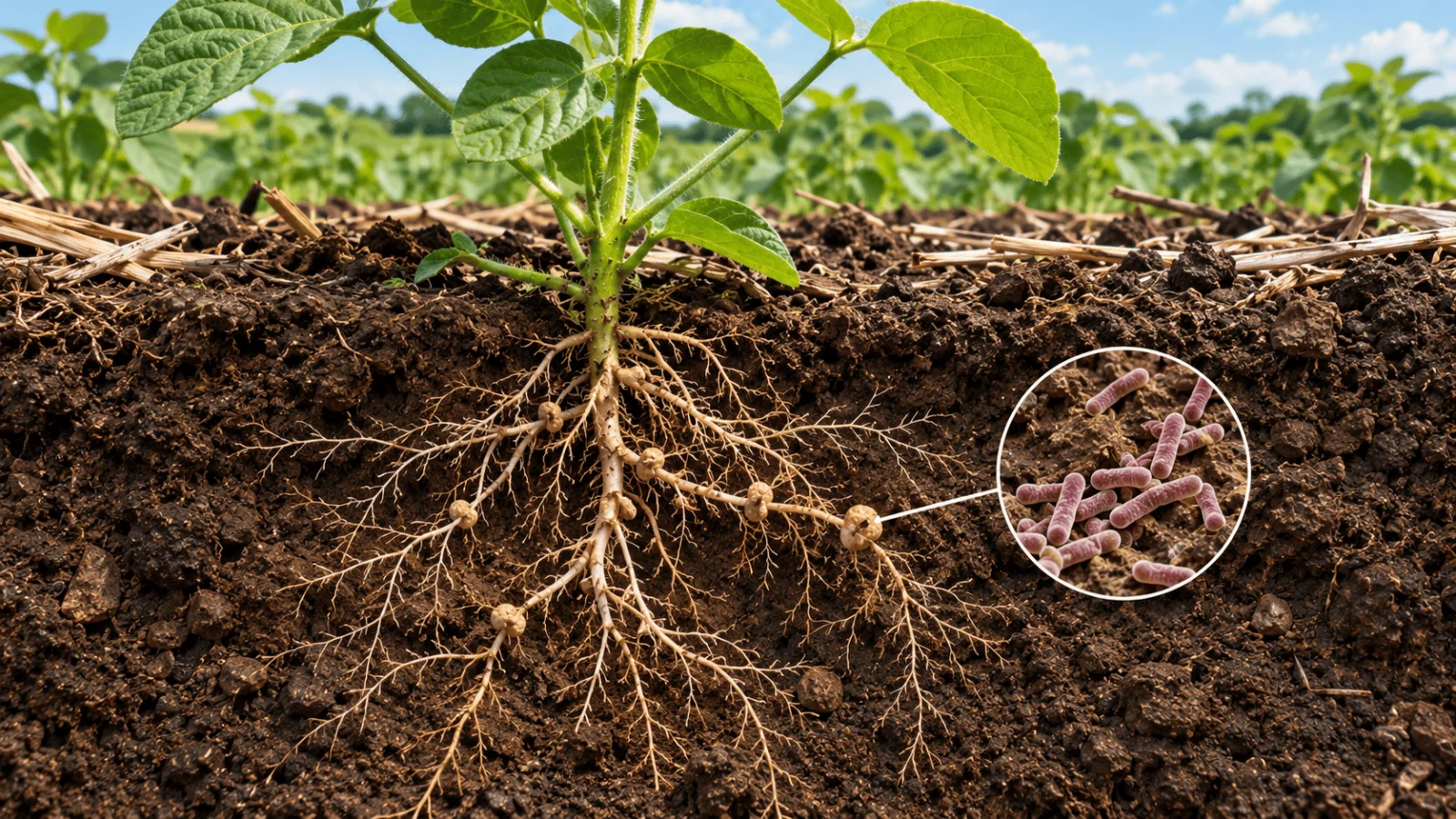
In terrestrial systems, nitrogen-fixing microbes may live freely in soil or in close associations with plants. Legume root nodules are the familiar example: the plant supplies carbon and a protected microenvironment, while symbiotic bacteria provide newly fixed nitrogen; a related Cabdirect article on [alsike clover and nitrogen fixation](/plants/alsike-clover-breeding-bulgaria-plants) describes this function in a forage legume. Kuypers, Marchant and Kartal (2018) note that nitrogenase, the enzyme system responsible for biological fixation, is oxygen-sensitive, which helps explain why many nitrogen-fixing organisms use specialised physiological or spatial strategies. The presence of a legume alone does not make atmospheric nitrogen directly available to surrounding plants; fixation depends on an active microbial partnership and the fixed nitrogen must still enter soil or biomass pools.
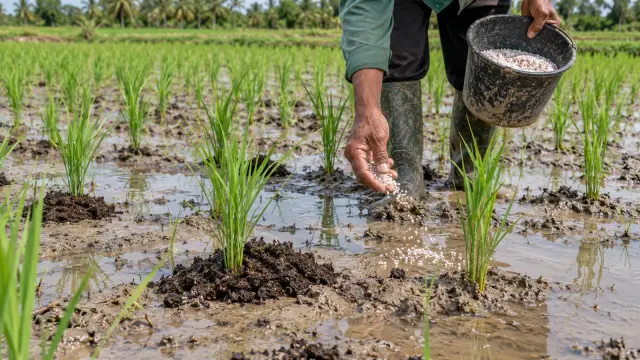
Fixation does not mean that all newly fixed nitrogen immediately reaches a crop. Nitrogen can first enter microbial biomass, plant tissue or organic residues and later be recycled through decomposition, while some may be exported in harvested material. That distinction matters for interpreting [fertiliser source effects on rice and soil](/agriculture/fertilizer-types-rice-yield-soil-properties-sri-agriculture), where nutrient form, release rate and soil conditions influence how much nitrogen becomes available during the growing season. Biological fixation can reduce reliance on external nitrogen inputs in suitable systems, but its contribution is variable and should not be treated as a fixed replacement value across soils or crops.
Nitrification changes ammonium into mobile nitrate
Nitrification oxidises reduced nitrogen, usually beginning with ammonia or ammonium and progressing through nitrite to nitrate. This matters because nitrate is readily used by many plants but is also relatively mobile in soil water, so nitrification can connect a retained ammonium pool with both plant uptake and leaching. Missouri Extension, reviewed in 2022, highlights nitrate mobility as a central link between the nitrogen cycle, soil fertility and water quality. Because nitrification is generally associated with oxygenated conditions, changes in aeration and wetness can alter how quickly ammonium is converted after mineralisation or fertiliser addition.
The organisms responsible for nitrification are more diverse than older textbook models suggested. Könneke et al. (2005) isolated an autotrophic ammonia-oxidising archaeon, demonstrating that ammonia oxidation is not confined to bacteria. Subsequent soil work by Leininger et al. (2006) showed that archaeal ammonia oxidisers can be abundant and active in terrestrial soils. Together, these findings established Archaea as important nitrifiers in marine and terrestrial environments and showed why ammonia oxidation cannot be inferred reliably from a narrow list of classical bacterial genera.
A second revision came from the discovery of complete ammonia oxidation, or comammox. Daims et al. (2015) cultivated a Nitrospira bacterium able to carry out both major oxidative steps from ammonia to nitrate, whereas the classical model divided those steps between separate ammonia- and nitrite-oxidising organisms. The result did not make the two-part model obsolete, but it showed that a single microorganism can sometimes perform complete nitrification. For soil ecology, the broader lesson is that the same chemical transformation may be carried out by different microbial groups whose importance changes with substrate supply and habitat conditions.
Denitrification and other losses remove nitrogen from soil
Denitrification reduces nitrate through a sequence of nitrogen intermediates, including the gases nitric oxide and nitrous oxide, and can ultimately return nitrogen to the atmosphere as N₂. It is favoured where oxygen is limited and suitable electron donors are available, conditions that can develop in water-filled soil microsites even when the whole field is not continuously saturated. The pathway can pass through nitrite, nitric oxide and nitrous oxide before N₂ is formed, although not every organism carries the full set of steps. This makes denitrification both a mechanism of nitrogen removal and a possible source of intermediate gaseous products.
Nitrous oxide can be produced and consumed within microbial nitrogen transformations, especially pathways associated with nitrification and denitrification. Butterbach-Bahl et al. (2013) stressed that soil N₂O production cannot be assigned to one simple switch: microbial community composition, oxygen, moisture, carbon, mineral nitrogen, pH and physical soil structure all influence the balance among pathways. This complexity is one reason emission estimates from a laboratory soil cannot automatically be transferred to a field. It also means that the same soil can alternate between retaining nitrate and losing nitrogen as gases as rainfall, aeration and substrate supply change.
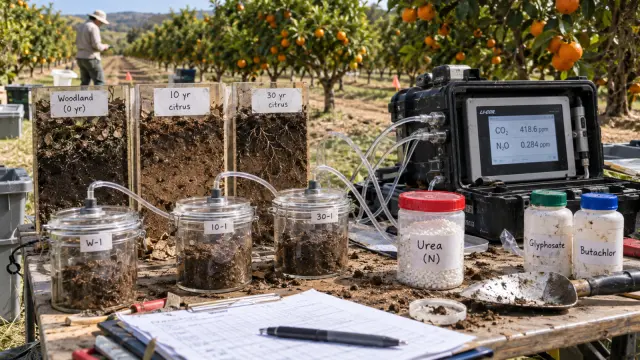
Nitrogen can also leave the root zone without being converted to N₂. Nitrate can move downward with drainage, dissolved nitrogen can leave in runoff, ammonia can volatilise, and harvested biomass physically exports nitrogen from the site; these routes have different controls and environmental consequences. A related explainer on [soil nitrogen transformations and N2O](/agriculture/citrus-orchard-herbicides-soil-nitrogen-emissions-agriculture) illustrates how the same added urea can produce different nitrification, denitrification and gas responses in soils with different management histories. The nitrogen cycle therefore includes both microbial transformations and physical transport, and the two often interact.
Fertiliser and plant uptake reshape soil nitrogen flows
Nitrogen is an essential plant nutrient because it is built into amino acids, proteins, nucleic acids and chlorophyll. Fertiliser adds reactive nitrogen to the soil system, but application is only the starting point: microbes and roots compete for ammonium and nitrate, organic matter can temporarily immobilise nitrogen, and water movement can carry nitrate away before plants acquire it. The final fate therefore depends on timing and soil conditions as well as on the amount added. Fertiliser does not bypass the natural cycle; it enlarges one or more reactive nitrogen pools that are then processed by the same biological and physical pathways.
Mineral fertilisers can supply readily available nitrogen, whereas organic materials contain mixtures of immediately available and organically bound forms that must be mineralised. That difference changes the timing of ammonium and nitrate production and can alter microbial activity, while organic inputs also bring carbon that can influence immobilisation and denitrification. The evidence reviewed in [organic and conventional farming research](/agriculture/organic-vs-conventional-farming-economics-ecology-agriculture) also shows why environmental outcomes depend on crop, soil, management and the unit used for comparison rather than on a simple organic-versus-mineral label. Equal total nitrogen inputs therefore do not guarantee equal nitrogen availability at the same point in the season.
Several controls act together when fertiliser nitrogen enters soil. Wetness and oxygen affect nitrification and denitrification; carbon availability can stimulate microbial immobilisation or denitrification; pH influences microbial communities and chemical equilibria; and roots remove inorganic nitrogen as they grow. Temperature and the timing of rainfall also change microbial activity and transport, so nitrogen that is well synchronised with crop demand in one season may be vulnerable to loss in another. The nitrogen cycle explains both why fertiliser can raise productivity and why some applied nitrogen may later appear in groundwater, surface water or the atmosphere.
Human activity has unbalanced the global nitrogen cycle
Agriculture, fossil-fuel combustion and industrial nitrogen fixation have increased the creation and movement of reactive nitrogen. Vitousek et al. (1997) documented how human activities had already altered nitrogen availability and mobility across terrestrial, freshwater and marine ecosystems, while Galloway et al. (2008) described continuing growth in agricultural and combustion-related nitrogen inputs and the inefficiencies that allow reactive nitrogen to cascade through multiple environmental compartments. Haber-Bosch fertiliser production creates reactive nitrogen deliberately for food production, whereas combustion also produces oxidised nitrogen compounds that can be transported and deposited away from the original source.
A newer synthesis shows that the imbalance has continued. Almaraz et al. (2026) compiled global nitrogen budgets and estimated that the annual amount of reactive nitrogen entering the biosphere increased fivefold from the 1960s to recent decades; the same review estimated terrestrial nitrogen accumulation on the order of about 50 Tg N per year between 1959 and 2025. Those are global budget estimates with substantial uncertainty, not measurements from a single experiment. The authors also identify terrestrial fixation and denitrification as major uncertainties, so the apparent imbalance should be read with the ranges and assumptions of global accounting in mind.
Extra reactive nitrogen can increase crop production where nitrogen is limiting, but nitrogen that escapes plant and microbial demand can contribute to nitrate leaching, eutrophication, acidification and gaseous losses. The environmental effect depends on where the nitrogen goes next, which is why the same atom may move through crop biomass, soil organic matter, groundwater, atmospheric ammonia or nitrous oxide before it is finally returned to N₂. Galloway et al. (2008) used the idea of cascading effects to capture this repeated movement through environmental systems. Human influence is therefore not a separate pathway in the cycle; it changes the size and speed of several existing pathways at once.
What is established and what remains uncertain
The central microbial roles are well established. Biological fixation brings atmospheric N₂ into reactive forms, mineralisation recycles organic nitrogen, nitrification oxidises ammonium towards nitrate, and denitrification removes nitrate through gaseous pathways. Culture studies such as Könneke et al. (2005) and Daims et al. (2015) also show that the organisms performing these reactions are more diverse and metabolically flexible than earlier classifications implied. The chemistry of the transformations can be described clearly even when the identity and relative abundance of the active organisms differ among soils.
What remains difficult is scaling from a microbe or soil core to a landscape and then to the globe. Kuypers, Marchant and Kartal (2018) describe overlapping microbial networks rather than isolated functional boxes, while Butterbach-Bahl et al. (2013) show how strongly nitrogen-gas production depends on local biotic and abiotic controls. Almaraz et al. (2026) likewise identify terrestrial fixation and denitrification among the largest uncertainties in attempts to close the global nitrogen budget. Detecting a functional gene or a potential microbial pathway is not the same as measuring the rate at which that pathway is operating in a particular soil.
The nitrogen cycle is therefore both a robust framework and an active research problem. The chemistry of the major transformations is not in doubt, but the rates at which they occur vary across soils, seasons, management systems and microbial communities. Canfield, Glazer and Falkowski (2010) show that the cycle itself has evolved over geological time, while modern research continues to uncover new microbial routes and revise flux estimates. The most defensible reading is to treat the cycle as a set of connected processes whose relative importance changes with environmental conditions, not as a fixed sequence that runs at one universal speed.
Frequently asked questions
Why can’t most plants use nitrogen gas directly?
Atmospheric N₂ has a very strong triple bond, and ordinary plant metabolism cannot break it. Nitrogen first has to be converted into reactive forms before plants can use it; biological nitrogen fixation and industrial Haber-Bosch synthesis are two important routes. Plants then acquire nitrogen mainly as nitrate or ammonium and incorporate it into proteins, nucleic acids and other cellular compounds.
Which soil microbes take part in the nitrogen cycle?
Different bacteria and Archaea carry out nitrogen fixation, ammonia oxidation, nitrite oxidation, complete nitrification and denitrification, while decomposer microbes release nitrogen from organic matter. The groups are not arranged as a simple relay. Their activity overlaps and changes with oxygen, moisture, carbon availability, pH, temperature and plant demand.
Why is nitrate more likely to leach from soil?
Nitrate carries a negative charge and is generally weakly retained by the negatively charged surfaces that dominate many soils. When water drains below the root zone, dissolved nitrate can move with it. The risk depends on soil texture, drainage, rainfall, rooting depth, nitrogen supply and how quickly plants or microbes take nitrate up.
Does all fertiliser nitrogen stay available to crops?
No. Once fertiliser enters soil, its nitrogen joins the same pools used by microbes and plants. Some may be taken up by roots, immobilised in microbial biomass or organic matter, while some can be lost through leaching, runoff, volatilisation or gaseous microbial pathways. The proportions vary strongly with soil and weather conditions.
How do human activities change the nitrogen cycle?
Humans add reactive nitrogen through fertiliser production, agriculture, fuel combustion and waste streams, increasing the amount moving through soils, water and the atmosphere. Almaraz et al. (2026) estimated a fivefold rise in annual reactive nitrogen entering the biosphere since the 1960s, while also stressing substantial uncertainty in global flux estimates.
Sources
- University of Missouri Extension. Nitrogen in the Environment: Nitrogen Cycle. Reviewed November 2022; originally published September 2017. https://extension.missouri.edu/publications/wq252
- Canfield DE, Glazer AN, Falkowski PG. The evolution and future of Earth's nitrogen cycle. Science. 2010;330(6001):192–196. DOI: 10.1126/science.1186120.
- Könneke M, Bernhard AE, de la Torre JR, Walker CB, Waterbury JB, Stahl DA. Isolation of an autotrophic ammonia-oxidizing marine archaeon. Nature. 2005;437(7058):543–546. DOI: 10.1038/nature03911.
- Kuypers MMM, Marchant HK, Kartal B. The microbial nitrogen-cycling network. Nature Reviews Microbiology. 2018;16(5):263–276. DOI: 10.1038/nrmicro.2018.9.
- Daims H, Lebedeva EV, Pjevac P, et al. Complete nitrification by Nitrospira bacteria. Nature. 2015;528(7583):504–509. DOI: 10.1038/nature16461.
- Butterbach-Bahl K, Baggs EM, Dannenmann M, Kiese R, Zechmeister-Boltenstern S. Nitrous oxide emissions from soils: how well do we understand the processes and their controls? Philosophical Transactions of the Royal Society B: Biological Sciences. 2013;368(1621):20130122. DOI: 10.1098/rstb.2013.0122.
- Vitousek PM, Aber JD, Howarth RW, Likens GE, Matson PA, Schindler DW, Schlesinger WH, Tilman DG. Human alteration of the global nitrogen cycle: sources and consequences. Ecological Applications. 1997;7(3):737–750. DOI: 10.1890/1051-0761(1997)007[0737:HAOTGN]2.0.CO;2.
- Galloway JN, Townsend AR, Erisman JW, et al. Transformation of the nitrogen cycle: recent trends, questions, and potential solutions. Science. 2008;320(5878):889–892. DOI: 10.1126/science.1136674.
- Almaraz M, Sun X, Davidson EA, et al. Fluxes and imbalances in the modern global nitrogen cycle. Nature Reviews Earth & Environment. 2026;7:656–671. DOI: 10.1038/s43017-026-00821-y.
- Leininger S, Urich T, Schloter M, et al. Archaea predominate among ammonia-oxidizing prokaryotes in soils. Nature. 2006;442(7104):806–809. DOI: 10.1038/nature04983.

Dr Olivia Bennett — author
Olivia Bennett works across author, reviewer and editor functions in the Environment & Climate area. Her academic background covers climate science, environmental policy and ecology, and she is affiliated with the Greenhaven Climate Research Institute. Her cov...
Related
How Orchard Age and Herbicides Shift Soil Nitrogen and N2O
How fertiliser types affect rice yield and soil under SRI
Organic vs Conventional Farming: Economics and Ecology

Can Alsike Clover Be Bred for Bulgaria’s Lowland Pastures?

Waituna Lagoon and Sea-Level Rise: What the 2019 Study Found

Luffa cylindrica fibres for contaminant removal research
How external resistance shapes azo dye removal in microbial fuel cells