Maize Chlorotic Mottle Virus: Distribution, Spread and Control
Maize chlorotic mottle virus (MCMV) is a maize-infecting virus whose importance rises sharply when it occurs with certain potyviruses, producing maize lethal necrosis (MLN). The 2014 distribution map recorded MCMV in parts of Asia, Africa, North America and South America, providing a snapshot of a pathogen that was already moving beyond its earlier American range.
This explainer separates the 2014 map from later reports, then examines symptoms, transmission, seed risk, diagnosis and disease management. Because the 2014 record is a distribution map rather than an experiment, later peer-reviewed studies are used to explain mechanisms and control without attributing those findings to the map.
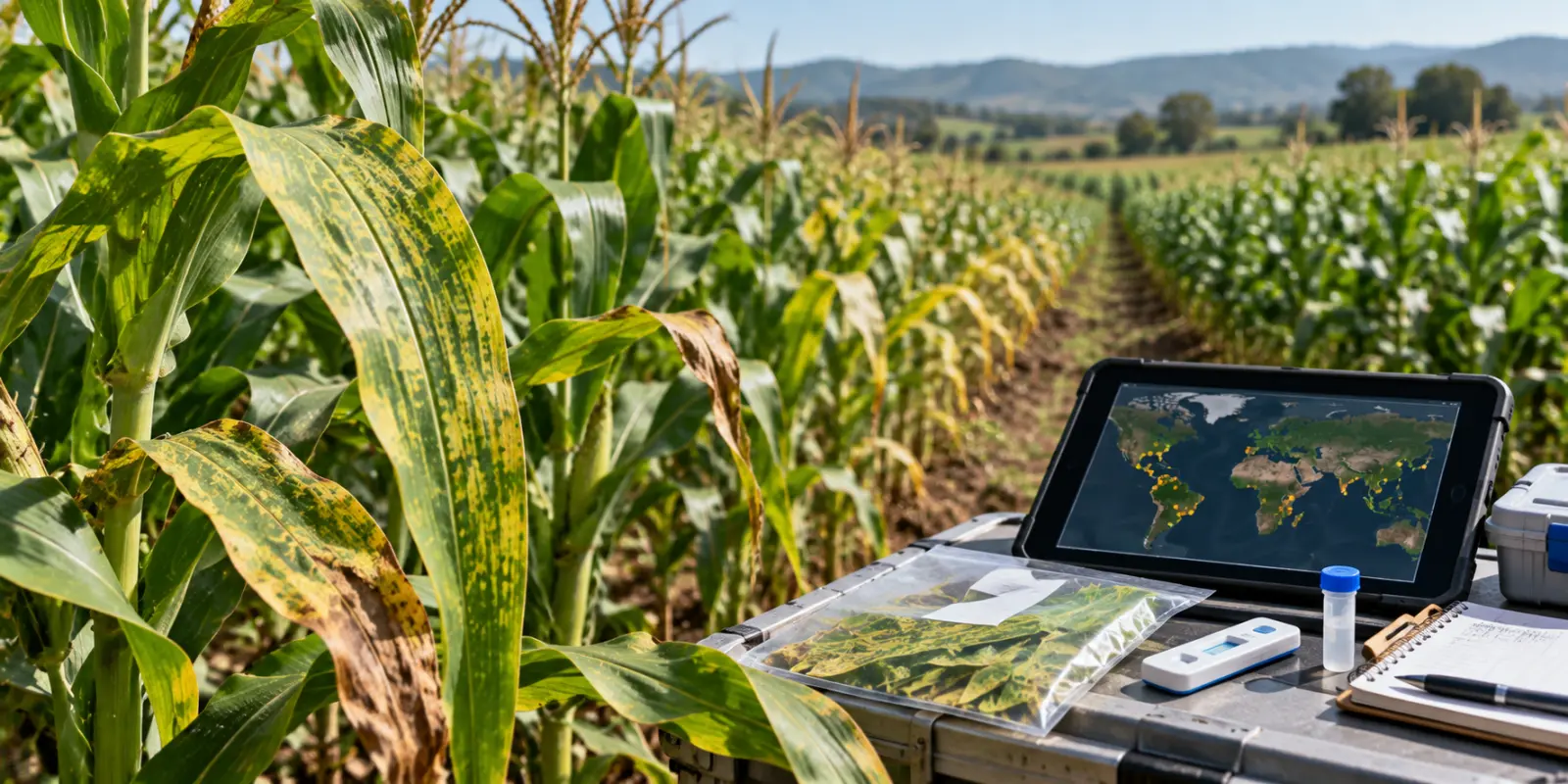
What the 2014 distribution map recorded
The distribution map was published as Map 912, Edition 2, in April 2014. Its abstract listed MCMV in Asia, Africa, North America and South America. In Asia, it recorded China, including Hebei, Sichuan and Yunnan, and Thailand. In Africa, it listed Kenya, Mozambique, Tanzania and Uganda.
In North America, the map included Mexico and the United States, with records from Hawaii, Kansas, Nebraska and Texas. In South America, it listed Argentina, Brazil and Peru. These locations should be read as the distribution documented for that edition of the map, not as a permanent or exhaustive list of every place where MCMV has subsequently been detected.
The mapped distribution was a geographic snapshot
Region | Locations listed in the 2014 map | Interpretation |
Asia | China (Hebei, Sichuan, Yunnan); Thailand | Documented distribution in that map edition |
Africa | Kenya; Mozambique; Tanzania; Uganda | Early East African expansion was already visible |
North America | Mexico; USA (Hawaii, Kansas, Nebraska, Texas) | Long-established American records |
South America | Argentina; Brazil; Peru | Includes the region where MCMV was first described |
Later reports expanded the known distribution
Subsequent surveillance showed why a static map has to be dated. In 2016, MCMV was confirmed in maize and the perennial grass Sorghum halepense in Spain, representing the first published report from Europe. EPPO also reported additional African countries affected by maize lethal necrosis after the initial Kenyan outbreak and documented MLN in Ecuador in 2016.
Current plant-health databases therefore maintain continuously updated pest records rather than relying on a single historical map. EPPO now lists the preferred species name Machlomovirus zeae while retaining Maize chlorotic mottle virus and MCMV as recognized names. The older terminology remains widely used in crop-protection literature, especially in discussion of MLN.
MCMV alone and maize lethal necrosis are not the same disease
MCMV can cause chlorotic mottling and mosaic in maize by itself, but the most destructive syndrome associated with the virus is maize lethal necrosis. MLN results when MCMV coinfects maize with one of several viruses in the family Potyviridae, most often sugarcane mosaic virus in East African outbreaks.
The interaction is synergistic rather than merely additive. Reviews describe severe chlorosis, necrosis, plant stunting, poor ear formation and, in susceptible plants, death or negligible yield. This distinction matters diagnostically: visible symptoms can suggest MLN, but laboratory testing is needed to identify the viruses involved.
A distribution map shows where a virus has been reported; it does not by itself explain why disease becomes severe there.
The East African outbreak changed the importance of MCMV
MCMV became a major international concern after severe disease appeared in Kenya in 2011. A 2012 Plant Disease report confirmed MCMV and coinfection with sugarcane mosaic virus in symptomatic maize from Kenya, establishing the first report of MCMV and MLN in Africa.
The outbreak occurred in an agricultural setting where maize was grown repeatedly, susceptible varieties were common and insect vectors were abundant. Later reviews concluded that the introduction of MCMV into regions already supporting maize-infecting potyviruses can transform a relatively mild mottle disease into a severe MLN problem.
Symptoms can overlap with other maize disorders
Early MLN symptoms can include mottling, chlorotic streaking and yellowing, followed by leaf necrosis and a 'dead heart' appearance in severe cases. However, nutrient disorders, other viruses and mixed infections can produce overlapping symptoms. Field appearance is therefore useful for surveillance but insufficient for definitive diagnosis.
Insect vectors are central to secondary spread
MCMV is transmitted by several insect groups, including chrysomelid beetles and thrips. Vector importance varies by region because the local insect fauna, climate and cropping pattern determine how efficiently virus moves from infected plants to healthy maize.
Once MCMV is introduced, vector-mediated secondary transmission can amplify disease rapidly within and between fields. This is one reason surveillance focuses not only on infected plants but also on crop continuity, volunteer maize, alternate grass hosts and vector pressure.
Seed transmission exists, but measured rates can be very low
Seed has long been considered a potential pathway for long-distance movement because MCMV can be detected on or in seed lots. Modern work has added an important quantitative distinction between contamination and successful transmission to a growing seedling.
In a 2023 study, more than 85,000 seeds from infected plants were evaluated and overall seed transmission was measured at 0.004%. The virus was abundant in maternal tissues such as the pericarp and pedicel but was not detected in embryo or endosperm tissues, helping to explain why transmission occurred rarely despite detectable virus in seed lots.
Low seed transmission can still matter in plant-health systems
A very low transmission frequency does not mean seed movement is irrelevant. If even a small number of infected seedlings establish in an area with efficient vectors and susceptible maize, they may provide starting points for secondary spread. That is why clean-seed production, testing and phytosanitary precautions remain part of MLN management programmes.
Diagnosis relies on laboratory confirmation
Surveillance programmes use serological and molecular tools to distinguish MCMV from other causes of mottling and necrosis. Methods reported in research and disease-management programmes include ELISA-based assays and reverse-transcription PCR, with sampling protocols designed to detect MCMV and the potyviruses that can participate in MLN.
Accurate diagnosis supports more than case confirmation. It allows seed lots to be evaluated, outbreaks to be mapped, resistant germplasm to be screened and disease-free production areas to be protected. Because coinfection determines MLN severity, testing for MCMV alone does not fully characterize a suspected MLN outbreak.
Resistance breeding has become a major control strategy
Following the East African epidemic, CIMMYT and partners established intensive MLN screening programmes, including artificial inoculation at the Naivasha screening facility in Kenya. These programmes identified resistant or tolerant germplasm and accelerated the release of hybrids adapted to affected regions.
A 2020 review described a broader disease-management strategy built around resistant varieties, improved diagnostics, regional surveillance, clean seed, phytosanitary coordination and farmer awareness. Host resistance is especially valuable because it reduces reliance on trying to suppress every vector or eliminate every source of inoculum.
Integrated management reduces opportunities for virus establishment
No single intervention removes all MLN risk. Current technical guidance combines several measures that act at different points in the disease cycle. These measures are particularly important in regions where MCMV is already established or where maize is grown continuously.
Key measures include:
- using resistant or tolerant maize varieties where they are available;
- producing and exchanging seed with strong MCMV testing and phytosanitary controls;
- avoiding continuous maize where rotation with non-host crops is practical;
- removing volunteer maize and managing sources of infection around production fields;
- monitoring vectors and disease symptoms, then confirming suspect cases with diagnostics;
- maintaining regional surveillance so new incursions are detected early.
Why the 2014 map remains useful
The 2014 distribution map remains valuable because it records a specific stage in the global emergence of MCMV. It captures the virus after its expansion into East Africa but before later reports added Europe and other locations to the known distribution.
For modern readers, its greatest value is historical and epidemiological. Comparing a dated map with later reports illustrates how plant-disease distributions change through surveillance, trade, vector movement and improved diagnostics. It also shows why archive records should retain their original geographic claims rather than being silently updated with information published years later.
What the map can and cannot establish
The map establishes where MCMV had been reported according to the sources used for that 2014 edition. It does not measure prevalence, incidence, yield loss or the probability that any listed region would experience MLN. Nor does a country-level record indicate that the virus was uniformly distributed across that country.
Those limits are important when using distribution data in risk assessment. Disease impact depends on susceptible maize, presence of compatible potyviruses, vectors, cropping intensity, seed movement and local management. Geographic presence is therefore one part of disease risk, not a complete measure of severity.
A distribution record is also shaped by surveillance intensity. The absence of a country from a historical map does not prove that the virus was absent; it may mean that no confirmed report was available to the compilers at that time. Conversely, adding a country to a later distribution does not show when the virus first arrived unless the underlying detection history is known. This is why dated maps are most informative when they are read as records of documented occurrence rather than complete reconstructions of viral movement.
Diagnostic methods are another part of that history. As surveillance expands and laboratory testing improves, infections that were previously unrecognised can become visible without any sudden change in the biology of the virus. Comparing editions of a distribution map can therefore reflect both genuine spread and improved detection. The map itself cannot distinguish between those explanations, so geographic updates need to be interpreted alongside the reports and diagnostic evidence on which they are based.
For maize lethal necrosis, this distinction is particularly important because MCMV presence alone does not define the full disease situation. Severe MLN depends on interaction with compatible potyviruses as well as susceptible maize and local epidemiological conditions. A country-level MCMV record therefore identifies a component of risk, not a uniform prediction of crop loss. Modern surveillance is most useful when occurrence data are combined with diagnostics, information on co-infecting viruses, crop distribution and management context.
The historical map should therefore be treated as a dated evidence layer. Its value increases when the publication year is kept visible and later records are added separately rather than merged into the original distribution. That approach preserves the chronology of detection and prevents modern geographic knowledge from being projected backwards onto a 2014 source. This separation between historical evidence and current status is essential whenever archive maps are used for present-day plant-health interpretation or surveillance planning.
Frequently asked questions
What is maize chlorotic mottle virus?
Maize chlorotic mottle virus, commonly abbreviated MCMV, is a positive-sense RNA virus that infects maize and some other grasses. Current taxonomy places it in the species Machlomovirus zeae, genus Machlomovirus, family Tombusviridae. Infection alone can cause mottling, but its greatest impact occurs in maize lethal necrosis coinfections.
Where has maize chlorotic mottle virus been reported?
MCMV has been reported in multiple regions worldwide, including parts of Asia, Africa and the Americas. The 2014 distribution map recorded China, Thailand, Kenya, Mozambique, Tanzania, Uganda, Mexico, the United States, Argentina, Brazil and Peru. Later reports expanded the known range, so the 2014 list should be read as a dated snapshot.
Why is MCMV important in maize lethal necrosis?
MCMV is one required component of maize lethal necrosis. Severe disease develops when maize infected with MCMV is also infected with a compatible potyvirus, commonly sugarcane mosaic virus in East Africa. The synergistic coinfection can cause extensive chlorosis, necrosis, poor grain set and plant death in susceptible maize.
Can MCMV spread through seed?
Yes, but recent experimental work indicates that transmission from infected seed to seedlings can be very rare. A 2023 study measured an overall transmission frequency of 0.004% among more than 85,000 seeds tested. Even low rates matter because infected seedlings may seed local epidemics where efficient vectors are present.
How is MCMV and maize lethal necrosis managed?
Management is integrated rather than based on one treatment. Priorities include resistant or tolerant maize varieties, clean seed, diagnostic testing, surveillance, removal of volunteer maize, crop rotation where practical and measures that reduce opportunities for vector-mediated spread. Regional phytosanitary coordination is important because MCMV can move across production areas.
Sources
- Maize chlorotic mottle virus. Distribution Maps of Plant Diseases. 2014; Map 912, Edition 2. doi:10.1079/DMPD/20143156821.
- Wangai AW, Redinbaugh MG, Kinyua ZM, et al. First Report of Maize chlorotic mottle virus and Maize Lethal Necrosis in Kenya. Plant Disease. 2012;96(10):1582. doi:10.1094/PDIS-06-12-0576-PDN.
- Redinbaugh MG, Stewart LR. Maize Lethal Necrosis: An Emerging, Synergistic Viral Disease. Annual Review of Virology. 2018;5:301–322. doi:10.1146/annurev-virology-092917-043413.
- Prasanna BM, Suresh LM, Mwatuni F, et al. Maize lethal necrosis (MLN): Efforts toward containing the spread and impact of a devastating transboundary disease in sub-Saharan Africa. Virus Research. 2020;282:197943. doi:10.1016/j.virusres.2020.197943.
- Bernardo P, Barriball K, Frey TS, et al. Transmission, localization, and infectivity of seedborne maize chlorotic mottle virus. PLOS ONE. 2023;18(2):e0281484. doi:10.1371/journal.pone.0281484.
- Achon MA, Serrano L, Clemente-Orta G, Sossai S. First Report of Maize chlorotic mottle virus on a Perennial Host, Sorghum halepense, and Maize in Spain. Plant Disease. 2017;101(2):393. doi:10.1094/PDIS-09-16-1261-PDN.
- European and Mediterranean Plant Protection Organization (EPPO). Machlomovirus zeae (MCMV00). EPPO Global Database. Accessed 12 September 2026.
- Prasanna BM, ed. Maize Lethal Necrosis (MLN): A Technical Manual for Disease Management. CIMMYT; 2021.
- Murithi A, Olsen MS, Kwemoi DB, et al. Discovery and Validation of a Recessively Inherited Major-Effect QTL Conferring Resistance to Maize Lethal Necrosis Disease. Frontiers in Genetics. 2021;12:767883. doi:10.3389/fgene.2021.767883.

Maya Hartwell — author
Maya writes environment and plant science explainers, with an editorial focus on biodiversity, ecosystems, water quality, environmental pollution, plant biology, invasive plants, natural materials and the use of biological resources in environmental technologi...
Related

New Zealand Ferns and Allied Plants: A 1989 Field Guide

Koshihikari rice: marker-assisted heading-date gene transfer

State of the World’s Fungi 2018: what the report found

Wild fruit diversity and the origins of cultivated trees

How vermicompost affects growth and flowering in Liatris spicata

Sugar components of coconut sugar in Indonesia: study digest